Trout vs Salmon: Spots, Tail, Mouth, and Habitat Clues
Spot patterns, tail shape, mouth features and habitat clues to help you tell trout vs salmon apart and what to check before relying on one photo.
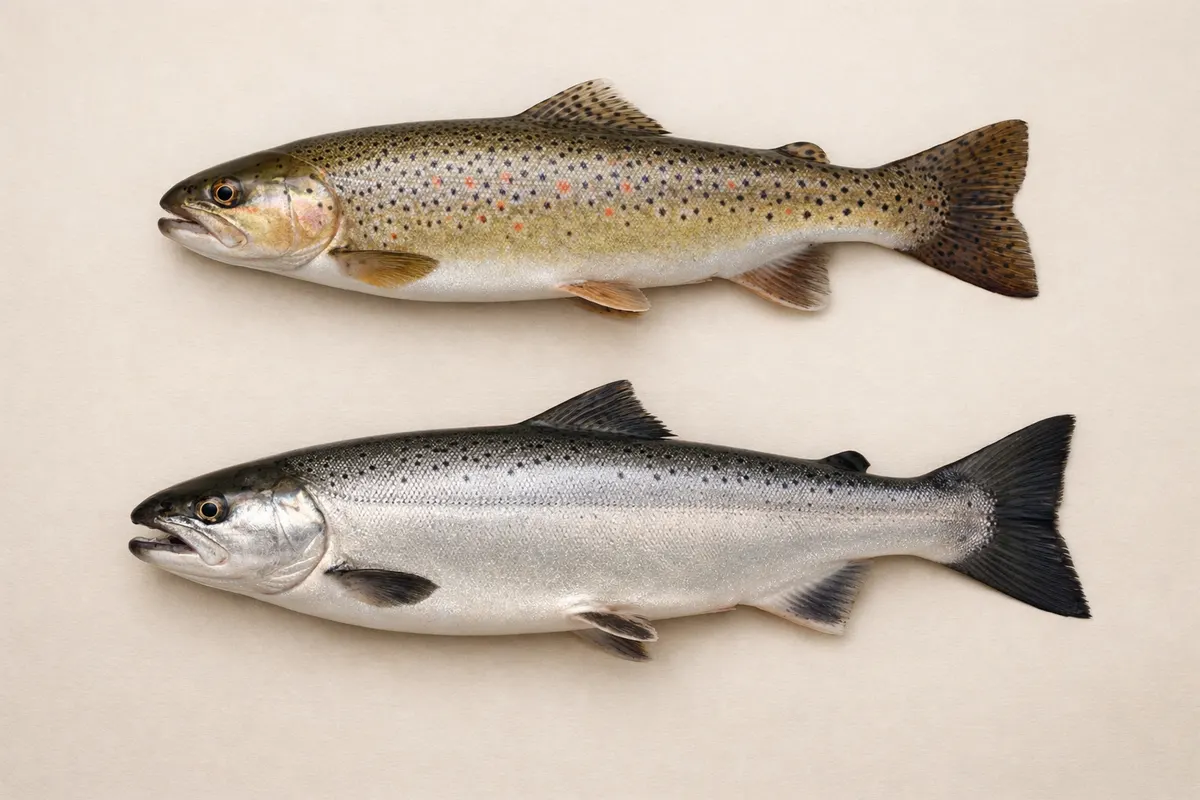
Quick answer for trout vs salmon
The fastest way to separate trout vs salmon in a photo is to combine three visible clues: body markings (spots or parr bars), tail shape, and mouth/jaw features. Trout species such as rainbow, brown, and brook usually show consistent spotting across the body and tail; salmon species often have cleaner sides when adults and develop more dramatic shape or color changes during migration.
Habitat and context matter: fish confined to small inland streams are more likely to be resident trout, while a fish caught in an estuary, river run, or near the coast during migration season is more likely to be a salmon or a sea-run trout. Time of year and behavior (schooling versus solitary) are strong supporting clues.
Treat any single clue alone as tentative. For confident ID, check tail fork shape (trout often have more rounded or square tails, many salmon have forked tails), look for a hooked jaw or 'kype' on spawning males (common in male salmon), and note spot distribution—spots extending onto the tail and head usually point to trout.
Comparison table
Below are practical, photo-focused comparisons across the most reliable visible clues, the level of confidence each clue provides, and the immediate next step you should take if the clue is present.
Use the bullets as quick inspection items when you have a side-profile photo plus one close-up of the tail or head. Combine clues: a single matching trait rarely gives certainty.
- Spot pattern — Trout: Often scattered dark spots across back, sides and tail (e. g. , rainbow and brown trout). Salmon: Adults usually have fewer spots on the body; some species like coho and chinook have spots on the back and tail but distribution differs. Confidence: medium. Next step: check whether spots continue onto the tail and compare with known species in your region.
- Tail shape — Trout: tails can be more rounded or slightly emarginate; many trout show spotting on the tail. Salmon: tails often more deeply forked and narrow, especially in adults. Confidence: medium-high when tail photo is clear. Next step: crop a clean image of the caudal fin for a closer look.
- Mouth & jaw — Trout: mouth usually ends at or before the eye; spawning trout can change but less dramatically. Salmon: adult males often develop a hooked jaw (kype) during spawning; juvenile salmon and smolts won’t show this. Confidence: high for spawning males; low for non-spawning fish. Next step: look for jaw shape and teeth detail in head shots.
- Color and spawning changes — Trout: color shifts are subtle; brook trout show vermiculations and red spots with blue halos. Salmon: many species turn bright or dark during spawning (sockeye red, chum patterned). Confidence: medium. Next step: record time of year and water type to interpret color changes.
- Juvenile marks — Trout and salmon juveniles both show parr marks (vertical bars), but context helps: parr in small streams could be trout or young salmon; smolt stage (silvery body with fewer marks) suggests anadromous salmonids. Confidence: low without habitat and size. Next step: include a scale or ruler in photos and note whether the fish was in brackish/coastal water.
When to use each
Use the trout identification path when the fish comes from small, nutrient-rich streams, lakes, or inland ponds and you see extensive spotting across the body and tail. Anglers frequently rely on spot distribution and the presence of characteristic color patterns (for example the red stripe of a rainbow trout) to identify a trout from photos.
Use the salmon identification path when the fish was seen near tidal waters, estuaries, or in a river run during migration season, or when you observe traits linked to migration and spawning—forked tail, reduced spotting on the sides, and a hooked jaw in males. Salmon runs also often produce noticeable changes in body shape and color that are less common in resident trout.
If you have mixed clues—say, a spotted fish in an estuary—treat the result as exploratory: note the location, season, and behavior and seek additional photos (tail close-up, head profile, full side view). In areas with sea-run trout (steelhead) the ecological clue alone isn’t decisive and you’ll need more visible detail.
- Trout path: small streams, visible tail spotting, spots extending onto head — likely trout.
- Salmon path: estuary/coastal run, forked tail, hooked jaw during spawning — likely salmon.
- Mixed or sea-run cases: collect more photos and context before concluding.
Common confusions
Sea-run trout (steelhead) are frequently mistaken for salmon. Steelhead are rainbow trout that migrate to sea and return to spawn; adults can look similar to salmon in size and behavior but retain rainbow trout spot patterns. When you see a salmon-like setting with trout-style spots, consider steelhead as a likely explanation.
Juveniles and smolts can be misleading. Young salmon and trout both show parr marks (vertical bars) that fade as they grow or migrate. Without size reference and water context, parr marks alone don’t reliably distinguish the two groups.
Color changes during spawning produce dramatic differences that confuse casual observers. A fish photographed during a color shift—bright red, darkened flank, or blotchy pattern—may seem to match the wrong species if you compare it only to adult photos taken outside of spawning season.
- Sea-run trout (steelhead) mimic salmon size and habitat but keep trout-style spots.
- Parr marks on juveniles are shared by both groups—use habitat and size to narrow possibilities.
- Spawning color shifts can hide typical species markings—note season and behavior.
Verification path
Before you act on an identification (for cooking, selling, reporting a catch, or adding to a record), collect a short checklist of photos and context. Start with: a clean side profile of the fish, a close-up of the tail, a head shot showing the jaw, and a photo that includes a scale or ruler for size. Add notes about location (freshwater, brackish, saltwater), time of year, and observed behavior.
If the side view shows abundant spots extending onto the caudal fin and in the head region, that strengthens a trout ID. If the tail is deeply forked, spots are reduced on the flanks, or a hooked jaw appears in a male during spawning season, that points toward salmon. Combine these clues rather than relying on a single trait.
For uncertain cases, consult a second source: a regional field guide, local fishery agency, or a specialized site article that explains how to collect better evidence. If you want a systematic first pass from photos, try the Fish Identifier app on your device (https://fish-identification. app/) after you’ve gathered the photos and habitat notes. Treat the app’s result as research input—verify with local expertise or an identification key before making decisions that affect safety, legality, or commerce.
If you plan to measure gill rakers, scale counts, or other diagnostic features that require handling, follow local rules and ethical practices for fish handling and permits. Many advanced diagnostic traits require a specimen and experienced examination; if you cannot or should not handle the fish, prioritize good photographs and contextual notes instead.
- Photo checklist: full side profile, tail close-up, head close-up, object for scale.
- Context notes: exact location (stream, river, estuary), date, water type, behavior observed.
- Use the Fish Identifier app for a first-pass photo analysis, then confirm with regional guides or fishery staff when the ID matters.
Related guides
Double-check your ID with Fish Identifier
After you collect clear photos and habitat notes, use the Fish Identifier app (iOS) at https://fish-identification. app/ for a first-pass analysis. Treat the app result as research: confirm unclear cases with regional guides or fishery experts before decisions that affect safety, legality, or sale.

Frequently asked questions
Can you identify trout vs salmon from a single photo?
Sometimes you can make a likely call from a single high-quality side photo that shows spot distribution, tail shape, and mouth profile, but a single image often leaves uncertainty. Best practice is to add a tail close-up and a head shot, plus location and time of year, before relying on the identification.
How does habitat help tell trout from salmon?
Habitat is a strong supporting clue: resident trout live in lakes and small streams year-round, while many salmon species move between ocean and rivers and are common in estuaries and river runs during migration. Habitat alone shouldn’t be the sole determinant but it raises or lowers the likelihood of each group.
What about sea-run trout like steelhead—are they trout or salmon?
Steelhead are rainbow trout that migrate to sea and return to spawn; they are trout by species but can look very similar to salmon because of size and behavior. Look for trout-style spot patterns and the distinctive pink lateral stripe of rainbow/steelhead to differentiate them from salmon.
When do salmon develop a hooked jaw (kype)?
A hooked jaw or kype typically appears in adult males during the spawning phase and is a strong visual clue for salmon during runs. Juvenile salmon and non-spawning adults won’t show a pronounced kype, so absence of a hooked jaw doesn’t rule out salmon outside the spawning season.