Fish Identification
Bluegill: Identification, Habitat, and Real Examples
Identify bluegill from photos with fin, mouth and colour clues, lookalike checks against other sunfish, and where and when you are most likely to find one.
Bluegill explained: what a bluegill is and where it lives
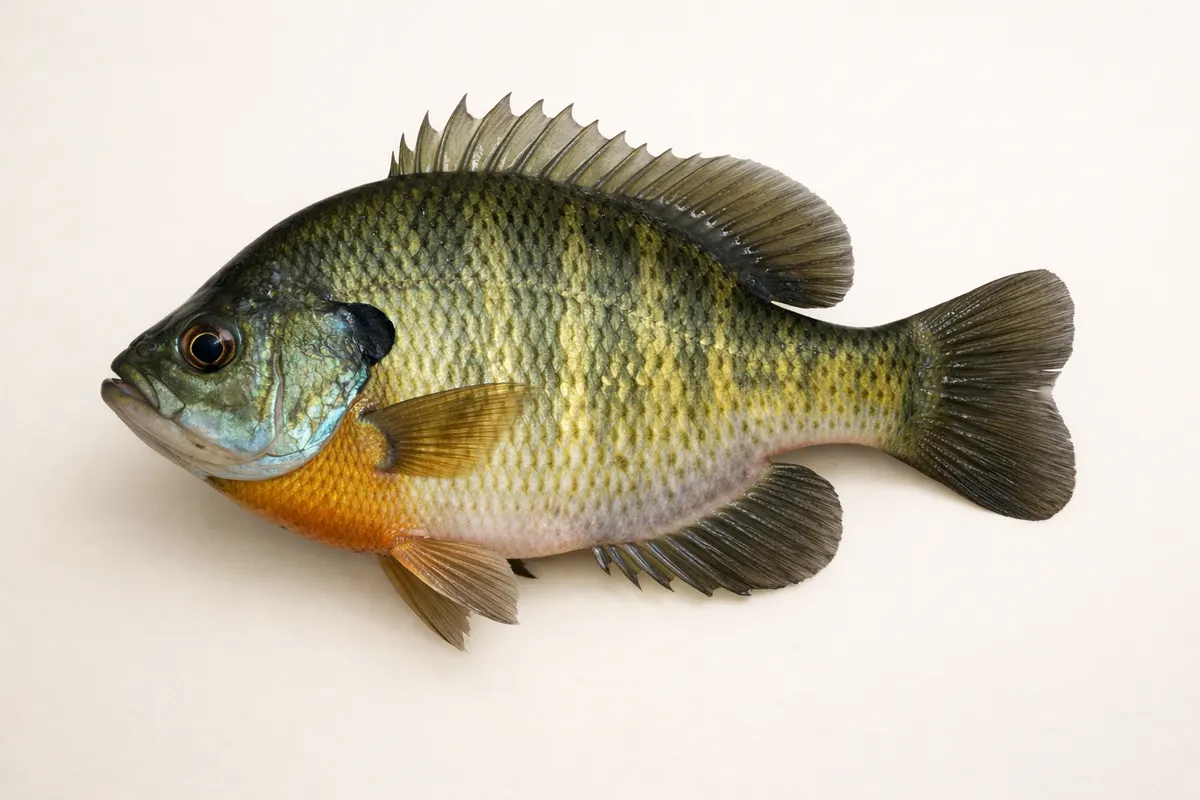
A bluegill (Lepomis macrochirus) is a common freshwater sunfish native to North America, easily found in ponds, lakes, and slow-moving streams. Adults usually have a deep, laterally compressed body, a small mouth, and an opercular flap — the dark flap at the rear edge of the gill cover — that often shows a distinct black spot.
Bluegill are omnivores: they feed on insects, crustaceans, and plant material, and they are an important forage species for larger game fish. Size at maturity is typically 4–10 inches (10–25 cm), though local conditions and food supply influence growth. They spawn in shallow nests in spring and early summer, often in colonies along graded shorelines.
Because they are widespread and tolerant of varied water conditions, bluegill are frequently the first species anglers encounter in freshwater fishing. They appear in recreational fisheries, bait markets, and occasionally the aquarium trade where colorful males are valued for display.
Identifying a specimen as a bluegill matters for both ecological and practical reasons: it helps anglers choose bait and tackle, guides stocking or release decisions, and sets realistic expectations about size and behavior when you see a fish in a photo.
What to check in photos — bluegill identification
Photos can provide many of the clues needed to identify a bluegill, but angle, lighting, and size reference matter. Start by photographing both flanks, the head in profile, and the posterior opercular flap. Note the fish’s overall shape: a rounded, deep body with a short, blunt snout is typical.
Coloration helps but varies with age, sex, and water clarity. Adult males often show olive to dark blue backs with orange or yellow on the belly and vertical banding or spotting on the sides. Females and juveniles are usually duller and more mottled. Look for a single dark spot on the rear edge of the gill cover and fine vertical bars on the sides.
Fin structure and counts are useful photo-checkable signals: bluegill have a single continuous dorsal fin with a spiny front portion and softer rays behind it. The pectoral fins are long and pointed compared with many other sunfish. When fins are fanned in a clear shot you can see the shape differences.
Context clues in the picture—habitat (weedy shallows versus rocky shoreline), presence of nest beds, and nearby species—often confirm an ID. If your photo shows a heavily serrated lower jaw or an unusually large mouth relative to the head, the fish may be a different species and merits closer comparison.
- Body shape: deep, round-bodied profile rather than elongated.
- Opercular flap: dark spot at the rear gill cover, sometimes with a faint blue edge.
- Dorsal fin: single, continuous fin with spines then soft rays.
- Color notes: males often show orange-yellow belly; regional color intensity varies.
- Side pattern: thin vertical bars or mottling on flanks in many adults.
- Pectoral fins: comparatively long and pointed versus stubby in some lookalikes.
- Size context: typical adult photos include scale references (hand, ruler, or lure).
- Behavioral hint: nesting colonies in shallow water are often bluegill spawning sites.
Quick facts and key specs for bluegill
This compact table lists the species name, typical dimensions, habitat, and other field-focused facts useful when you’re comparing a photograph to known bluegill traits.
Use the table below as a checklist when examining photos: several matching rows together increase confidence, while a single matching trait alone is rarely definitive.
| Attribute | Typical | Notes |
|---|---|---|
| Scientific name | Lepomis macrochirus | Common sunfish species in lakes, ponds, and slow rivers |
| Family | Centrarchidae (sunfishes) | Includes pumpkinseed, crappie, and other sunfishes |
| Adult length | 4–10 in (10–25 cm) | Large individuals in well-stocked waters can exceed this range |
| Identifying marks | Dark opercular flap spot; vertical flank bars | Opercular flap shape and spot contrast are key photo clues |
| Habitat | Shallow weedy areas, docks, rocky shores | Often near structure and vegetation; nests in gravelly shallows |
| Diet & behavior | Omnivore; diurnal feeder | Feeds on insects, small crustaceans, and zooplankton |
Where and when you'll find bluegill
Bluegill are a warm, shallow, weedy-water fish. The native range runs from the Great Lakes and the Mississippi basin east to the Atlantic slope, south through Florida and west into Texas and northern Mexico, and a century of stocking has added farm ponds, park lakes and reservoirs across nearly every other state and several other continents. Look where cover meets shallow water: lily pads and weed edges, boat docks, sunken brush, riprap and the slack backwaters of slow rivers. They rarely stray far from structure, which is why so many bluegill photos are taken from a bank or a dock rather than from open water.
Season sets both where they are and how they look. In spring, as shallow bays warm through the high 50s Fahrenheit, they move up to feed; from roughly 67 to 80 degrees the males sweep saucer-shaped nests into sand or gravel and hold in tight colonies, and that is when the orange bellies and dark flank bars are at their strongest. Southern waters repeat the spawn in waves through the summer. Once the water drops below about 50 degrees the fish school over deeper flats and breaks, still reachable through the ice but noticeably paler and less marked in photographs.
| Season | Water temperature | Where to look | What you'll see |
|---|---|---|---|
| Early spring | About 50-65F | Shallow dark-bottomed bays and channels that warm first | Scattered fish feeding up in the water column, colors still muted |
| Late spring to early summer | About 67-80F | Colonies of saucer-shaped nests on sand or gravel in 1-4 ft of water | Aggressive males on the beds with the deepest orange bellies and hardest contrast of the year |
| Summer | Above 75F | Weed edges, dock shade, brush piles and the first drop-off | Small fish shallow all day, larger fish sliding deeper until dusk |
| Late fall and winter | Below 50F | Deeper flats and steep breaks, commonly 12-25 ft | Tight schools and washed-out flanks, often photographed on the ice |
Species that look like bluegill and how to tell them apart
Bluegill are most often confused with other members of the sunfish family. Photos are usually sufficient to separate a bluegill if you check opercular flap shape, mouth size, and flank patterns carefully.
Here are the common lookalikes and the tell-tale photographic differences to watch for. A careful side-profile and clear view of the gill cover will resolve most misidentifications.
- Pumpkinseed: usually has brighter, more complex spots and a smaller, more rounded opercular flap; pumpkinseed often shows orange crescents on the cheek.
- Green sunfish: thicker, more robust jaw and larger mouth; often darker overall with a more pronounced green sheen and irregular spotting rather than vertical bars.
- Redear sunfish (shellcracker): similar body shape but a distinct red or orange margin on the opercular flap (near the ear), and generally a longer, narrower mouth.
Care and handling tips for bluegill
If you plan to release a caught bluegill, minimize air exposure and handle the fish with wet hands or a wet cloth to protect its slime layer. Support the body rather than hanging by the jaw when taking photos to reduce injury.
For short-term holding (bait or transport) keep water temperature stable, provide oxygenation, and avoid overcrowding. Aquarium hobbyists should provide hiding spots and a varied diet; bluegill can become territorial in small tanks.
When keeping a bluegill for display or taxidermy, record exact capture location and date. Provenance increases value for mounted specimens and provides useful ecological context for researchers and collectors.
Frequently asked questions
Bluegill vs sunfish: How can I tell which one I photographed on a pond bank?
Ask whether the fish shows a single dark opercular flap spot and thin vertical bars on the side; those features strongly suggest a bluegill. Compare mouth size and opercular flap shape in your photo: broader, patterned opercular flaps or a much larger mouth point to other sunfish like green sunfish or bass. If the photo shows a red margin on the ear flap, the fish is likely a redear (shellcracker), not a bluegill.
What are the fastest photo checks for bluegill identification when I only have one phone picture?
From a single image, prioritize (1) body shape: deep and rounded, (2) opercular flap: a dark spot near the gill cover, and (3) dorsal fin outline: a single continuous fin with spiny front rays. Also use any visible size reference (your hand, a lure) and habitat clues—shallow weedy water points toward bluegill. If those checks line up, your photo has strong supporting evidence; if not, gather more views before concluding.
How does season or location change bluegill appearance in photos?
Season affects color and behavior: breeding males in spring and early summer often display brighter bellies and stronger contrast, while winter fish look dull and muted. Location matters too—bluegill in tannin-stained waters can appear darker and less patterned, and fish from nutrient-rich ponds sometimes grow larger and show different color expression. Always interpret a photo in the context of time and place rather than relying on color alone.
Are there regional color variants I should know for bluegill identification?
Yes. Local water chemistry, diet, and genetics can produce regional variants—some populations show deeper blue tones, others stronger orange on the belly, and rare color morphs appear in the aquarium trade. These variants can confuse casual IDs, so prioritize structural markers (flap shape, body proportions, fin configuration) in photos, and treat unusual color as supportive but not definitive.
Related guides
Compare your photo to bluegill clues with Fish Identifier
Use the Fish Identifier iOS app to run a photo-based comparison against the bluegill traits on this page. Start with clear side and head views, note habitat and size references, and let the app highlight which visible clues match. Treat the app’s result as a first pass: it helps prioritize follow-up checks but does not replace expert verification or an in-person appraisal when needed.