
Fish Identification
Crappie: Identification, Habitat, and Real Examples
Learn how to recognize crappie by eye, which photo clues matter, and where and when you’re most likely to find them in freshwater lakes and rivers.
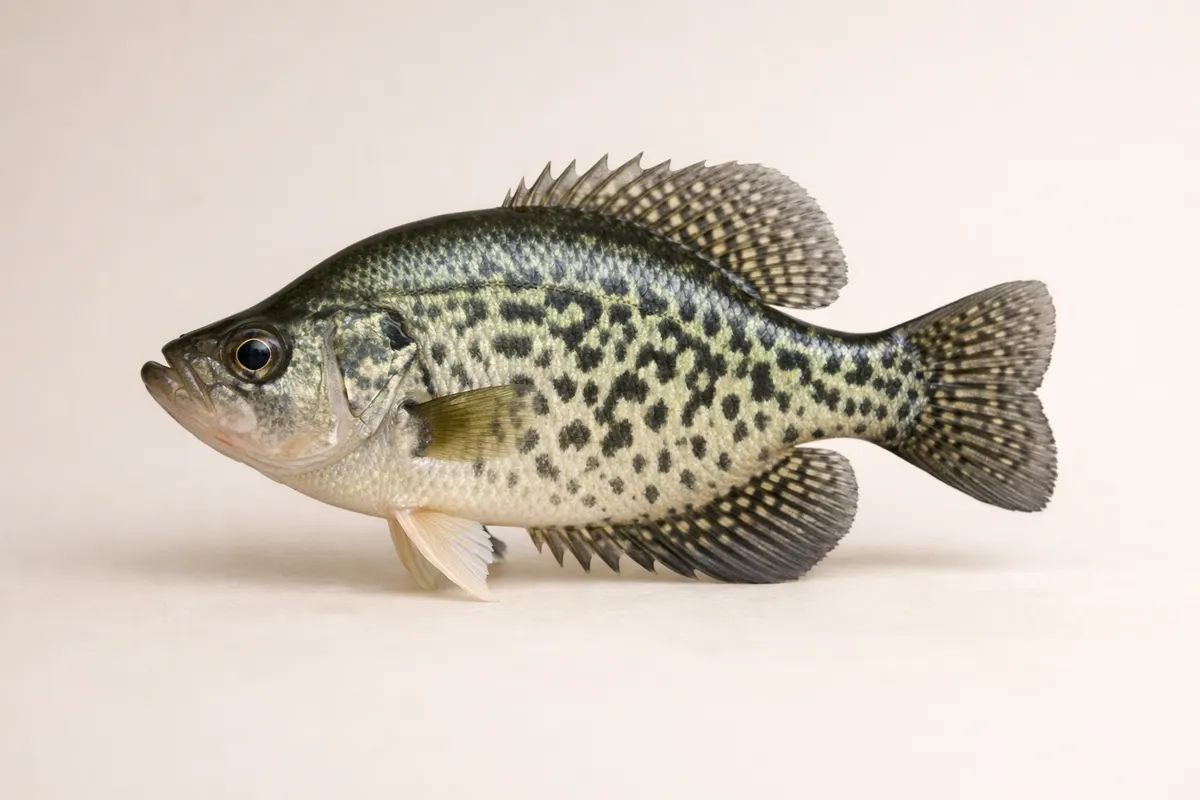
What a crappie is and why anglers notice it
Crappie is the common name for two closely related freshwater sunfish in the genus Pomoxis, known for their deep, laterally compressed bodies and schooling behavior. Adults typically measure 6–12 inches, though larger specimens reach 15 inches or more in productive waters.
Two species—often collectively called 'crappie'—are widely distributed across eastern and central North America in lakes, reservoirs, slow-moving rivers, and backwaters. They are valued by anglers for distinctive schooling near structure and their appetite for small baitfish.
What makes crappie recognizable is the combination of a nearly round, compressed body, a single dorsal fin with a pointed profile, and a mouth sized to feed on minnows. Color and contrast vary with water clarity and light; underwater hues often appear darker or greener than they do in air.
- Genus: Pomoxis; two species commonly encountered in inland U.S. waters.
- Typical adult length: most are 6–12 in (15–30 cm); maximums reach 15+ in in rich lakes.
- Habitat preference: quiet water with cover—fallen timber, brush piles, docks, and submerged vegetation.
How can you tell a crappie from a photo?
Start by checking overall body shape and proportions. Crappie have a deep, laterally compressed body with a blunt snout and a mouth that reaches to or past the front of the eye. The dorsal and anal fins are long and somewhat rounded, giving a boxy silhouette in profile.
Look for the dorsal-fin count and placement: crappie have a single dorsal fin with soft rays (no separate spiny dorsal), and the dorsal fin sits roughly midway along the back. Pectoral fins are low on the body and the tail is slightly forked but broad—details that show up well in side shots.
Spots, blotches, and scale contrast matter but can be misleading. Water color, depth, and camera white balance shift visible hues; use pattern layout and fin shape as stronger clues than absolute color. A clear close-up of the head and dorsal fin area is often enough to confirm a crappie.
Assess context clues in the photo: presence of submerged wood, schooling fish, or a shallow spring shoreline increases the likelihood it’s a crappie. When available, note the size relative to objects (lures, hands, dock boards)—proportions help separate crappie from similarly shaped sunfish.
- Body: deep, laterally compressed; blunt snout and a medium-sized mouth.
- Fins: single long dorsal fin with soft rays; broad, slightly forked tail.
- Pattern: irregular dark spots or blotches (variable with species and environment).
- Context: often photographed near cover—brush, timber, docks, or shallow vegetation.
Crappie at a glance: quick facts
This compact facts table highlights the most photo-relevant attributes for crappie. Use the rows to check a photo quickly: size, typical coloring, preferred habitat, active season, and the single most distinguishing feature to spot in images.
Keep in mind the range of values: coloration and exact size vary by population and conditions, so use the table as diagnostic guidance rather than absolute thresholds.
| Attribute | Typical details | Photo clues to check |
|---|---|---|
| Size | 6–12 in common; up to 15+ in | Compare to hand, lure, or dock boards for scale |
| Coloring | Silver to greenish with dark blotches | Spot pattern on sides and dorsal; avoid relying on hue |
| Habitat | Lakes, reservoirs, slow rivers, structure | Look for nearby logs, brush, docks in frame |
| Active season | Most visible spring through fall; spawning in spring | Schooling near shallow structure in spring |
| Distinguishing feature | Deep compressed body and single soft-rayed dorsal | Silhouette and dorsal fin shape in side view |
Where and when you're most likely to find crappie
Crappie are freshwater fish found across large parts of the continental U.S. and parts of southern Canada. They favor quiet water and are especially common in reservoirs, oxbow lakes, backwater sloughs, and the quieter pools of rivers where currents are low.
Seasonal behavior affects sighting probability. In spring, adults move into shallow bays and flooded timber to spawn and are often visible in clearer photos near shore. During summer and winter they may school at mid-depths around structure and require deeper or shaded shots to capture.
Time of day matters: low light during early morning and late afternoon often produces feeding activity near the surface and along edges, increasing the chance of clean photos. In stained water, look for shape and movement against the background rather than fine color.
| Region/Habitat | When you'll see them | What you'll notice in photos |
|---|---|---|
| Shallow bays & flooded timber | Spring (spawning) and low-light hours | Multiple fish near vegetation or logs; side-profile shots possible |
| Weed edges and docks | Spring through fall, mornings/evenings | Feeding behavior, clear silhouette against lighter water |
| Deeper structure (summer/winter) | Warmest part of day in summer; mid-depth in winter | Clustered schools; fewer close-up shallow shots |
| Slow river pools | Variable; often during low flow or calm conditions | Fish near submerged cover; current-blurred fins possible |
- Range: widespread across eastern and central North America; common in managed reservoirs.
- Typical settings: submerged timber, brush piles, docks, weed edges, and flooded shoreline.
- Seasonal notes: spring spawning brings crappie into shallow cover; summer schools deeper near structure.
Black crappie vs white crappie: spotting photo clues
The two Pomoxis species are often confused in photos. Black crappie (Pomoxis nigromaculatus) tends to have denser, smaller dark spots in a more mottled pattern, while white crappie (Pomoxis annularis) usually shows vertical bars or larger, more diffuse blotches spaced along the flank.
Look at the head and dorsal fin area: black crappie commonly has a higher dorsal fin and a more irregular dot pattern across the body, whereas white crappie often has a flatter profile and clearer vertical banding. However, juveniles and environmental staining can blur these cues.
Other lookalikes include sunfish such as bluegill and juvenile bass at certain sizes. When a photo only shows part of a fish (for example a head shot or an oblique angle), check fin counts and body depth against Pomoxis proportions before assigning species.
- Black crappie: dense, small spots; higher dorsal profile.
- White crappie: vertical bars or larger blotches; slightly deeper body.
- Bluegill confusion: bluegill have shorter bodies and a different mouth angle—compare fin length and mouth position.
- Compare with Largemouth Bass ID notes for bigger-mouthed fish: see Largemouth Bass: Identification, Habitat, and Real Examples (https://fish-identification.app/wiki/largemouth-bass).
Care and handling for photographed crappie
If you're handling crappie for a photo, minimize air exposure and support the fish horizontally. Their bodies are relatively thin and compressing them vertically (holding by the jaw only) can stress the spine and internal organs, especially in larger individuals.
Use wet hands or a wet cloth when you need to steady the fish for a shot, and return it to the water quickly if you plan to release. In warm conditions, perform photos and handling near the water to reduce recovery time.
Follow local fishing regulations and size limits before keeping any crappie. If you suspect a fish was injured during handling, keep it in a livewell with aerated water and avoid overcrowding until you can release or follow local guidance.
- Support body horizontally; avoid hanging by lower jaw alone on larger specimens.
- Use quick, careful photos; keep hands wet and handle near the water.
- Observe local rules and safety limits—do not treat this page as legal or harvesting advice.
Frequently asked questions
How can I improve crappie identification from a single photo?
Improve identification by capturing a clear side profile that shows body depth, dorsal fin shape, and the side pattern. Include an object of known size in frame for scale (lure, ruler, hand). Take additional shots from slightly above and from the head angle to reveal mouth position and pectoral fin placement. Note water clarity and lighting—overcast, even light reduces color distortion. When in doubt, record location and habitat (timber, dock, weed edge) to support the visual evidence.
Can I tell if a crappie is black or white from a low-resolution or distant picture?
Low-resolution photos often obscure the spot vs. bar pattern that separates black and white crappie. In distant shots, rely instead on body silhouette and dorsal profile; black crappie usually shows denser spotting and a higher dorsal profile, while white crappie tends to show vertical banding. If those cues are not visible, classify the image as 'likely Pomoxis' and seek closer images or contextual habitat notes before choosing a species.
When is the best time of year to photograph crappie for clear identification?
Spring, during pre-spawn and spawning movements, is the best time because crappie move into shallow, clear coves where full side profiles are easier to photograph. Early morning and late afternoon light improves contrast without harsh reflections. In summer and winter they school deeper around structure and are harder to photograph close-up, so aim for calm conditions and clear water when possible.
What should I check to avoid confusing crappie with similar sunfish in my photos?
Before concluding a photo shows a crappie, check: (1) body depth—crappie are deeper and more compressed than bluegill; (2) mouth size—crappie have mouths suited to small baitfish and often reach the front of the eye; (3) dorsal fin shape—single soft-rayed dorsal; and (4) pattern layout—spots or bars distributed over the flank. Cross-reference with local species pages such as Bluegill: Identification, Habitat, and Real Examples (https://fish-identification.app/wiki/bluegill) for direct visual comparisons.
Related guides
Compare your photo to these crappie clues
If you have a photo and want a first-pass comparison, Fish Identifier can highlight the fin and body clues listed here and show likely matches. Use the photo tool at https://fish-identification.app/tools/fish-identifier as one optional next step after you check the visible evidence and habitat notes. Remember: a single image can't guarantee species-level certainty—use multiple views and context when possible.
Take the next step →