Bass Identification
Bass Identification: Jaw, Fin and Flank Clues
Compare jaw position, dorsal fins and flank markings for bass identification. Learn which traits suggest a match and when a photo leaves uncertainty.
Bass identification starts with a few visible, repeatable clues: body shape, dorsal and tail fin placement, scale pattern, and the mouth’s reach. A clear photo that captures lateral profile, mouth, and caudal fin usually lets you narrow the fish to the bass group and often to species-level candidates.
Using a photo as a first pass saves time and avoids unnecessary handling. If the picture shows the jaw, the lateral stripe or bands, and the dorsal fin outline in one frame, an expert or a photo-identification tool can separate largemouth, smallmouth, striped hybrids, and white bass with reasonable confidence — and tell you which follow-up checks are still needed.
If you want field-level examples, try matching your images against species pages such as Largemouth Bass: Identification, Habitat, and Real Examples (https://fish-identification.app/wiki/largemouth-bass) for further discussion of the species. Check whether any image is a documented photograph or a generated illustration before using it as a reference.

How identification works
Step 1
Snap a photo
Take a clear, well-lit photo of your item in the Fish Identifier app.
Step 2
Get an instant identification
The app reads the visible clues and returns the closest matches in seconds.
Step 3
Review the details
Compare the result with your photo, review any uncertainty, and check the suggested next steps.
Visual signals to check for bass identification
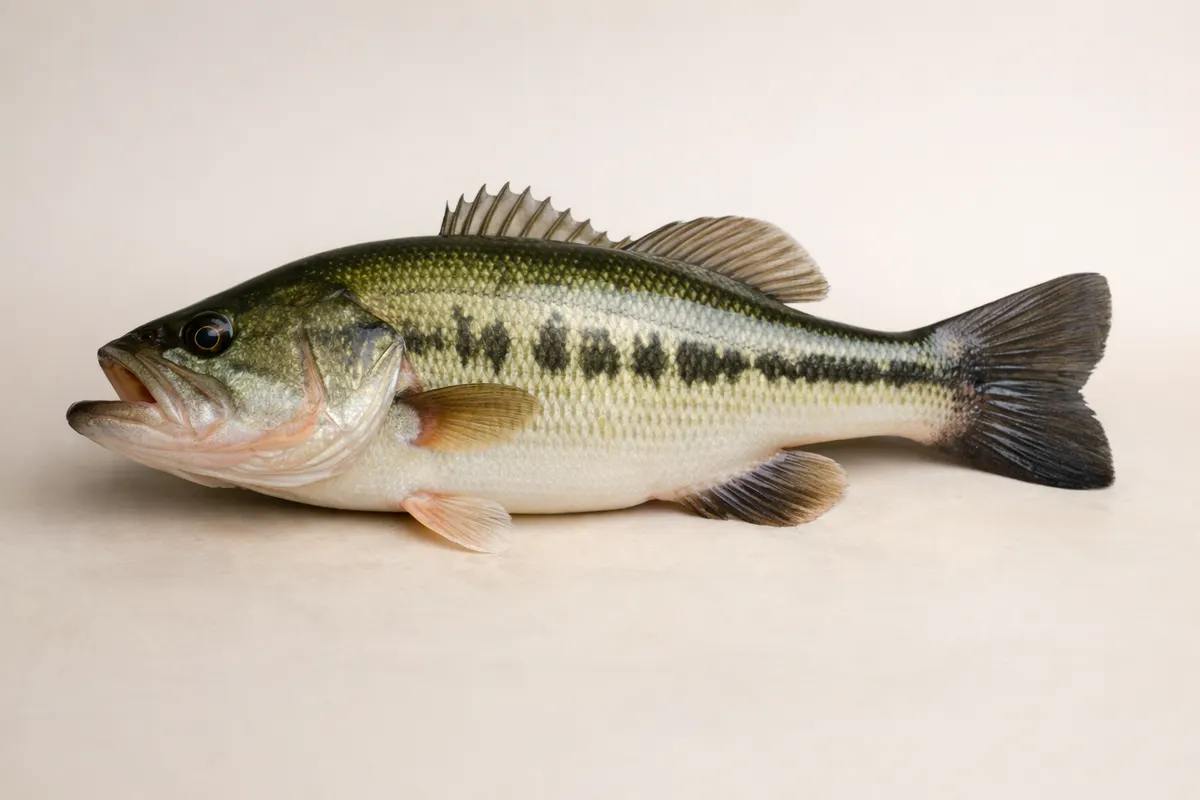
Start with overall body shape and mouth size. Largemouth-style bass have a deep body and an upper jaw whose rear end extends beyond the back of the eye when the mouth is closed; a more streamlined body and a mouth that stops at or before the eye point to other species. Pay attention to the angle of the head and the depth from dorsal to belly — those proportions are consistent within species.
Dorsal fin structure is diagnostic: count and note the notch between spiny and soft dorsal parts, and check whether the two sections are clearly separate or appear continuous. Fin shape and placement can separate common bass from hybrids or from similarly sized species.
Markings and scale patterns are critical: look for a continuous dark lateral stripe, broken vertical bars, or a series of spots along the lateral line. Lighting and water color change perceived contrast, so favor photos taken at perpendicular angles to the flank and with natural light when possible.
Context matters: size and location narrow possibilities. A bass caught in a rocky northern stream with bronze coloring is likelier to be a smallmouth; the same-sized fish in a warm lake with a wide mouth suggests largemouth. Note the habitat in your photo caption whenever you submit an image for identification.
- Jaw reach: compare the rear end of the upper jaw with the back of the eye while the mouth is closed; this is one clue among several.
- Dorsal profile: one continuous dorsal fin favors some species, a notched spiny-to-soft transition favors others.
- Flank pattern: largemouth bass often have a dark lateral band; smallmouth may show vertical bars. White and striped bass have multiple horizontal stripes and belong to a different family.
- Tail shape: a forked tail cannot establish hybrid ancestry. Compare multiple traits with a regional fish guide.
- If you suspect a smallmouth bass identification, look for olive-bronze sides, vertical banding, and a mouth that does not extend past the eye.
What a bass identification result shows
A category identification result explains which bass group the photo most likely matches and why, citing the visible evidence: body proportions, mouth position, dorsal fin shape and key markings. The result lists alternative candidates when visual signals conflict or are partially obscured.
Expect a compact itemized report: the suggested species or group, a short confidence note tied to the visible clues, recommended follow-up photos or checks (for example, a clear headshot to confirm jaw reach), and suggestions for further comparison. Do not assume that the result includes verified reference images or a calibrated probability.
Results also point out common uncertainty factors — lighting, angle, partial occlusion, or damaged fins — and advise whether a hands-on measurement (standard length, mouth-to-eye distance) or a different photo angle would be required for higher certainty. For practical examples of photo clues and next checks, see Identify Fish by Photo: Photo Clues, Fish Details, and Next Checks (https://fish-identification.app/blog/identify-fish-by-photo).
- Suggested species/group and ranked alternatives with brief evidence notes.
- Photo-quality feedback and the single best next photo to take if needed.
- Habitat and size context that increase or reduce confidence in the ID.
- Pointers that explain why the ID might be ambiguous and what to verify next.
Largemouth bass identification and common lookalikes
Compare largemouth bass with smallmouth and spotted bass using the upper jaw, dorsal-fin outline and flank pattern together. Assess the jaw with the mouth closed. A different camera angle or an open mouth can make the relationship to the eye misleading. A deep notch in the dorsal fin is another largemouth clue, while smallmouth have a more continuous dorsal outline.
Smallmouth often have bronze or olive sides and vertical bars; spotted bass can resemble largemouth but their upper jaw usually ends at or before the rear of the eye. Color is variable, so avoid using it alone. Missouri’s Smallmouth Bass guide explains these comparisons: https://mdc.mo.gov/discover-nature/field-guide/smallmouth-bass.
White bass, striped bass and their hybrids need a separate comparison. Several horizontal stripes, a silvery body and a forked tail suggest this group, but those traits do not prove a hybrid. Read a current regional agency guide when a catch remains uncertain; photographs may not show every useful feature.
Frequently asked questions
Hybrid striped bass identification: Can I tell from a single phone photo?
A single photo may suggest the white/striped bass group, but body shape and striping overlap among species and hybrids. Broken stripes or a forked tail alone do not prove hybrid ancestry. Compare several traits with the fish agency’s guide for that water and leave the identity unresolved when the necessary evidence is absent.
White bass identification: What marks separate it from young striped bass when I only have one snapshot?
White bass tend to be deeper-bodied than striped bass, but both can have multiple horizontal stripes. A single photograph may not separate young fish or hybrids reliably. Compare the full fish with a regional reference; Missouri provides a White Bass guide at https://mdc.mo.gov/discover-nature/field-guide/white-bass.
How accurate is bass identification from photos alone?
Photo-based identification can be accurate when the image captures key diagnostic features — jaw reach, dorsal profile, and lateral markings. Accuracy drops if the fish is obscured, the angle distorts proportions, or lighting hides contrast. Trusted results always describe the visual evidence and recommend specific follow-up photos where needed rather than offering absolute certainty.
When should I follow a photo bass identification with hands-on checks?
If the identification affects whether you may retain a fish, check the current rules for that water and obtain a reliable identification. Follow the authority’s specified measurement method; “standard length” is not a universal legal measure. Minimize handling and time out of water, and do not prolong an examination merely to support an app guess.
Related guides
Try Fish Identifier to narrow your bass ID
Use Fish Identifier at https://fish-identification.app/tools/freshwater-fish-identifier to compare possible identities from your photo. Treat the result as a starting point, verify missing field marks with a regional reference, and use the relevant fishery authority for current retention rules.