
Fish Identification
Northern Pike: Identification, Habitat, and Real Examples
Photo-focused northern pike guidance that covers identification marks, typical habitats and seasons, and the common species people confuse it with.
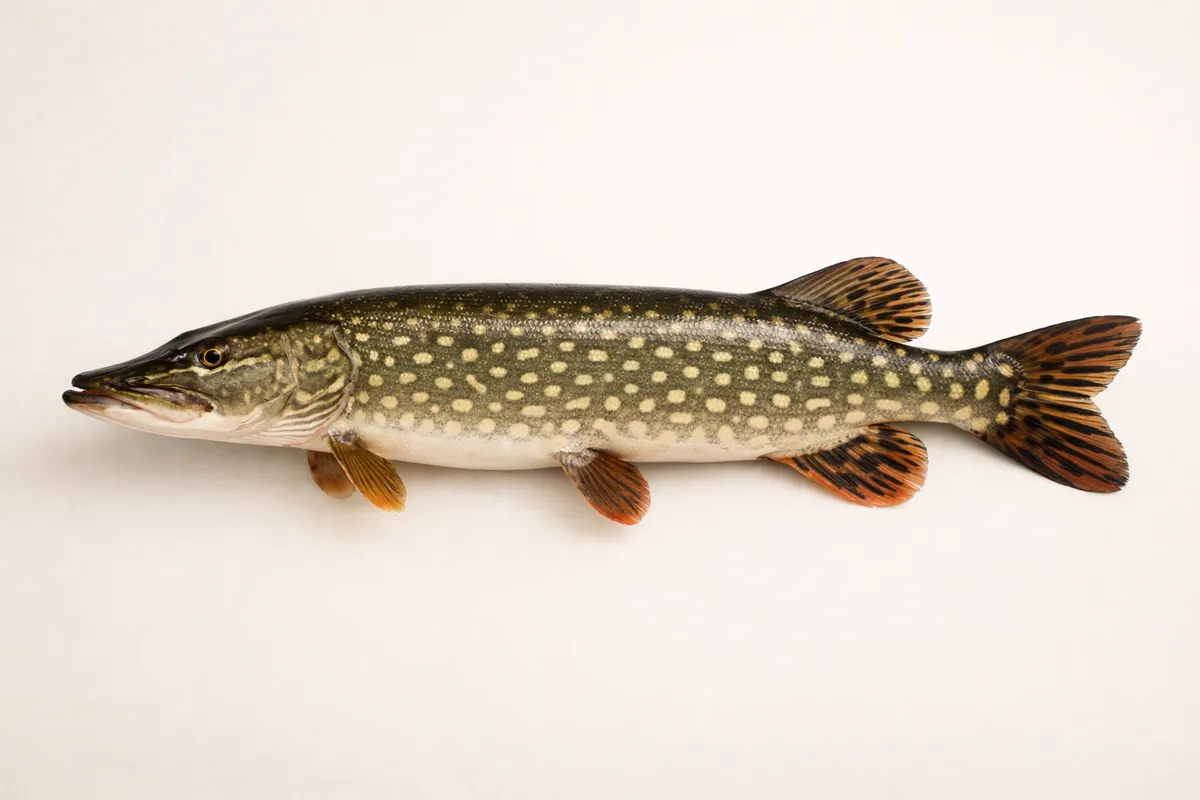
What a northern pike is and why it stands out
The northern pike (Esox lucius) is a large freshwater predator common across northern North America, Europe and parts of Asia. Adults usually range from 40–75 cm (16–30 in) in lakes and slow rivers, with larger specimens exceeding a metre in favorable habitat. It belongs to the pike family (Esocidae) and is known for an elongated, torpedo-shaped body, a flattened head and a mouth full of sharp teeth.
Pike are ambush hunters that rely on camouflage and burst speed. Their elongate profile, forward-set dorsal fin, and mottled pattern adapted to reedy habitats are consistent field traits. In many regions they are a flagship freshwater predator, often noticed by anglers, photographers and naturalists for their distinct body proportions and behavior.
When describing a fish as a northern pike from a photo, emphasize proportional cues—head shape, mouth size, dorsal and anal fin placement—and the mottled or spotted body pattern. Color can shift with water clarity and light, so proportions and fin positions are more reliable than hue alone.
- Family: Esocidae (pikes); scientific name Esox lucius.
- Typical adult size: 40–75 cm, with trophy fish >1 m in some lakes.
- Key behavior: ambush predator in vegetated shallows and backwaters.
Northern pike identification: photo-check clues
Start identification with body shape: pike are long and slender with a cylindrical mid-body that tapers sharply toward a narrow tail. A blunt, duckbill-like snout and a large mouth that extends well past the eye are diagnostic in clear photographs.
Fin placement is a strong photo-check: the single dorsal fin sits far back on the body, roughly opposite the anal fin. Pectoral and pelvic fins are lower and closer to the head than on many bass species. This rear-fin arrangement supports fast bursts off a still posture.
Pattern and texture help confirm a pike: adults commonly show light, bean-shaped spots or irregular vertical blotches on a darker green to olive background. Juveniles often display more distinct striping. Remember that water color, angle, and camera white balance change perceived tones; rely on pattern shape and fin positions before color.
- Head and mouth: flattened snout, mouth extends behind eye — look for teeth silhouette if visible.
- Fin layout: dorsal and anal fins set far back, nearly opposite each other.
- Body markings: light bean-shaped spots or vertical blotches on darker background.
- Proportions over color: use body shape and fin placement when light or water color distorts hue.
Key facts and quick reference for northern pike
The table below summarizes compact identification and life-history facts that are easy to reference from a photo or quick field note. Use the photo clues column to prioritize what to capture in an image: head profile, fin placement, overall pattern, and habitat context.
| Attribute | Typical value | Photo clues | Field notes |
|---|---|---|---|
| Size | 40–75 cm common; up to >1 m | Full-body photo with scale; elongate torso | Large size with long body and big head |
| Color & pattern | Olive/green background, light spots or blotches | Bean-shaped spots or vertical blotches on flanks | Juveniles may be more striped than spotted |
| Fin arrangement | Dorsal/anal fins set far back | Rear-positioned dorsal and anal fins visible in side shots | Helps separate pike from bass and trout |
| Head & mouth | Flattened snout; mouth with many teeth | Duckbill profile; mouth extends behind eye | Teeth rarely visible unless mouth open |
| Habitat | Vegetated lakes, slow rivers, backwaters | Photos showing reeds, lily pads, or shallow cover | Ambush predator—look for cover in frame |
- Keep a ruler or known-size object in photos when local regulations and safety allow; size provides context for species-age comparisons.
- Note the substrate and vegetation type in a photo—pike are strongly associated with emergent and submerged plants.
Where and when you'll encounter northern pike
Northern pike favor shallow, vegetated water where they can ambush prey from cover. They are common across boreal and temperate regions of North America and Europe. In addition to lakes they use river backwaters, oxbows and slow-moving channels where emergent and submerged plants provide concealment.
Seasonal behavior affects visibility: pike move into very shallow, vegetated water to spawn in spring and are more catchable and visible at that time. In mid-summer they may shift slightly deeper but still near structure; in autumn they feed heavily before winter and may be seen actively hunting in low light.
Time of day matters for sightings and photos. Pike are often most active at dawn and dusk when low light favors their ambush strategy. Clear, calm water increases the chance a photo will show pattern and fin placement accurately.
| Region / habitat | When you'll see it | What you'll notice |
|---|---|---|
| Northern lakes & ponds (N. America, Europe) | Spring and early summer | Shallow reeds, ambush from vegetated margins |
| Slow rivers and backwaters | Spring to autumn | Edge habitats, submerged logs, eelgrass beds |
| Shallow marshes & bays | Spring spawn | High concentration in very shallow water |
| Open-water zones near structure | Dawn/dusk feeding | Silhouette of long body, sudden bursts |
| Ice cover areas (winter) | Under-ice, low activity | Reduced surface movement; seen on sonar or through ice fishing |
- Habitat preference: dense submerged plants, reed beds, and weedy lake margins.
- Season: most visible during spring spawn and feeding peaks in autumn.
- Time of day: dawn and dusk increase activity and surface strikes.
Species commonly mistaken for northern pike and how to tell them apart
Several species share overlapping habitats and general shapes with pike; photos often confuse them, especially when only partial views are available. The most common lookalikes are muskellunge (muskie), chain pickerel, and large bass species in certain light.
Muskie (Esox masquinongy) is very similar in silhouette but tends to grow larger and often shows different spotting patterns and head proportions. Chain pickerel are smaller and have a distinctive chain-like lateral pattern and a dark bar under the eye. Large bass species such as largemouth bass have a different mouth-to-eye proportion and dorsal fin separation where the spiny dorsal is more distinct.
When comparing images, prioritize measurements and fin positions: the distance from the snout to the dorsal fin base, the shape of the tail peduncle, and the presence or absence of paired light bean-shaped spots are reliable photo clues.
- Muskie vs northern pike: muskie typically lacks the pike's regular bean-shaped spots and may have reticulated or vertical markings instead.
- Chain pickerel: smaller, chain-like pattern and a dark cheek bar; tail fork and proportion differ from pike.
- Largemouth bass: shorter, deeper body profile; dorsal fins separated by a notch, not set far back like pike.
- When photos are partial, include head, mid-body pattern, and a fin—those three elements cut confusion.
Care, handling, and safety around northern pike
If you catch or handle a northern pike, prioritize your safety and the fish's welfare. Pike have many sharp teeth and strong jaws; use long-nosed pliers or a dehooker to remove hooks and avoid placing fingers inside the mouth. A wet cloth over the lower jaw can help control the fish for quick photography or measurement.
Follow local rules on catch-and-release and size limits. Do not attempt to sell or trade a wild specimen; this article does not discuss pricing or commerce. When releasing, support the fish in the water until it can swim away under its own power—do not hold out of water for extended periods for photos.
If you suspect a fish is invasive or you find an unusual specimen, contact local fisheries authorities rather than attempting relocation yourself. Many jurisdictions have rules for transport and disposition of live fish to prevent the spread of invasive species.
- Use long-nosed pliers and wet hands to minimize handling injury.
- Keep out-of-water time brief; photograph quickly and return the fish to water.
- Follow local fishing regulations; do not move live fish between water bodies.
Frequently asked questions
When comparing a lake photo, how do I tell northern pike vs muskie when the pattern looks similar?
Compare head proportions and spot pattern first: northern pike often has bean-shaped light spots on a darker background, while muskie can show a more irregular reticulated pattern or vertical bars. Check the shape of the snout (pike’s snout is usually broader and blunter) and the distance from the eye to the dorsal fin—muskie typically have slightly different dorsal-base placement and a deeper body in large adults. When photos are ambiguous, capture a side profile including head, mid-body, and tail base; these elements together give the strongest discrimination.
What visible marks should I photograph for reliable northern pike identification?
Photograph a full side profile including head, mid-body pattern, and rear fin placement. Get a close shot of the snout and mouth if possible (without risking injury), and include habitat context like vegetation. These views let you check the flattened snout, the mouth extending past the eye, the rear-set dorsal and anal fins, and the characteristic spots or blotches—features that are more reliable than color alone.
Can a single photo prove a northern pike beyond doubt in a mixed-species lake?
A single, clear photo that shows head shape, fin placement, and full flank pattern can usually give high confidence, but never absolute proof. Partial views or color-shifted images can mislead—similar species overlap in size and habitat. If the identification matters for regulation or research, combine photos with measurements, location details, and (if allowed) an expert review rather than relying on one image alone.
How does water clarity and lighting affect northern pike identification from photos?
Water color and lighting change perceived hue and contrast; green water can mute spots, low light reduces visible detail, and surface glare obscures fin positions. For reliable identification, prioritize shots taken in cross-light (light at your back), a side profile to show fin placement, and a close head shot. If water turbidity prevents detail, document habitat and take multiple angles rather than relying on a single image.
Related guides
Compare your photo to these northern pike clues
After you check the head shape, fin placement and flank pattern in your images, use Fish Identifier to run a first-pass comparison against the same photo-check clues described here. The tool can highlight likely matches and show which clues it based the result on. Treat the app’s output as an evidence step—not definitive verification—and follow up with measurements, habitat notes, or local experts when you need confirmation. Try the tool at https://fish-identification.app/tools/fish-identifier to compare your photo against northern pike characteristics.
Take the next step →