Trout Identification
Trout Identification: Visual Clues to Tell Species Apart
Learn trout identification from photos and field checks: clear visual clues, how to spot lookalikes, and the safe next steps to confirm species.
A clear photo plus location notes can narrow trout identification to a few candidates. Compare spot pattern, any lateral stripe, tail markings and fin edges together. Common names can be confusing: brook trout are char, while rainbow and brown trout belong to other genera in the same salmon family.
Dark spots on a light background versus light spots on a dark background can be a useful first comparison, but it is not a complete identification. Juveniles, hybrids, seasonal color and glare complicate this distinction. Use several features and the species known from the waterbody together.
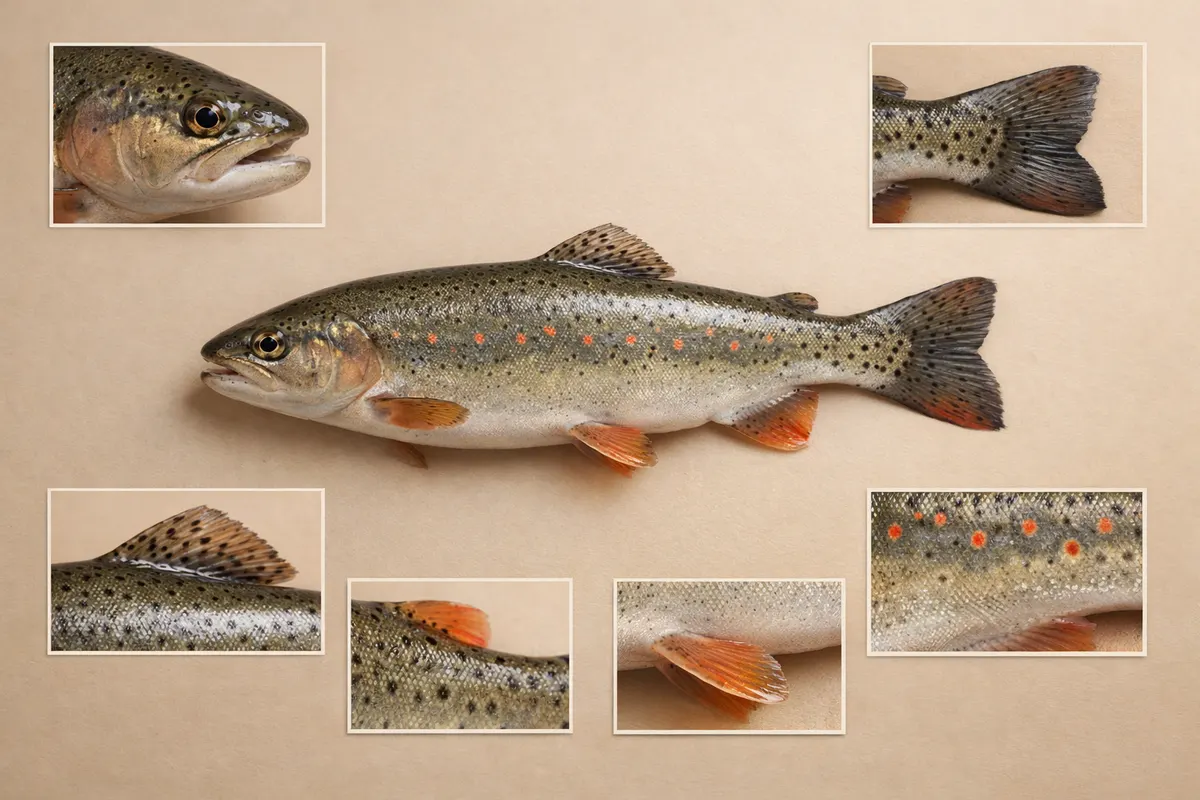
A photo identification is the fastest first pass because it highlights the features experts compare: body profile, dorsal and adipose fin shape, tail spot distribution, and the presence or absence of a pink lateral stripe. Use a photo to narrow candidates, then follow simple follow-up checks for confirmation.

How identification works
Step 1
Snap a photo
Take a clear, well-lit photo of your item in the Fish Identifier app.
Step 2
Get an instant identification
The app reads the visible clues and returns the closest matches in seconds.
Step 3
Review the details
Compare the result with your photo, review any uncertainty, and check the suggested next steps.
Practical visual signals for trout identification
Start with a full side view that includes the head, fins and tail. Trout, char and salmon share many body features, including an adipose fin, so the presence of that fin or a streamlined body does not separate them. Check a regional identification key before interpreting a single marking.
Spot pattern and coloration are the most photographable signals: look for dark spots on light flanks (typical trout) versus light spots on a darker background (typical char). Observe any pink or red lateral stripe, black spotting on gill covers, and whether the pelvic and anal fins have white leading edges.
Record the country, region and waterbody alongside an approximate length if it is already known. Location helps check whether a candidate occurs there. Size, schooling behavior and lake-versus-river habitat are supporting context, not reliable species tests by themselves.
- Rainbow trout: a pink side stripe and dark spots across the body and tail can support a match; color varies.
- Brown trout: larger dark or red spots may have pale halos, and the tail typically has relatively few spots.
- Brook trout: look for wavy markings on the back, red spots with blue halos and white leading edges on lower fins.
- Do not use a spotted tail or white fin edge alone: similar features occur in more than one species.
- Compare these features with the Washington Department of Fish and Wildlife identification guide (https://wdfw.wa.gov/sites/default/files/publications/00303/wdfw00303.pdf) and a reference for your own region.
What a trout identification result includes
A practical identification report lists the most likely species, the visual features that drove that conclusion, and a confidence level tied to what’s visible in the photo. Expect statements like “Most likely: Brown trout (Salmo trutta) — dark spots with light halo, pronounced dorsal spotting; moderate confidence.”
The result can flag lookalikes and missing details, such as the tail pattern or a clear side profile. Keep location notes for checking a local reference; the current uploader does not collect them. A photo result cannot determine legal retention, safe consumption or the handling rules for protected species.
The report does not guarantee species or provenance. Use existing photos and avoid harming or unnecessarily handling a fish to obtain extra details. For general photo guidance, see Identify Fish by Photo (https://fish-identification.app/blog/identify-fish-by-photo). Check local fisheries guidance independently before deciding whether a fish may be kept.
- Species suggestion and scientific name where possible.
- Key photo evidence cited (spots, stripe, fin edges) and a short why-it-matters note.
- Confidence level with clear limits and recommended follow-up checks.
- Practical care or handling notes when relevant (do not assume edibility from a photo).
Brown trout identification and common lookalikes
Brown trout (Salmo trutta) are often confused with rainbow trout and juvenile salmon. Photographs that capture the flank spot pattern, the presence of red or brown hues, and how spots sit relative to the lateral line are the most useful differences to check.
Brook trout are char. Their wavy back markings, red spots with blue halos and white lower-fin margins help distinguish them from brown trout. Other char have different combinations of marks, so a broad label such as “light spots” is only the start of a comparison.
Salmon can also have spotted tails: the WDFW guide shows different patterns for Chinook, coho and pink salmon. Kokanee are landlocked sockeye and lack distinct dark tail spots. Do not apply a single trout-versus-salmon rule across all species or life stages.
- Compare spot color and placement across the flank, back and tail.
- Check a regional key for the specific candidates, especially juveniles.
- Keep an identification provisional when important details are hidden.
Frequently asked questions
How do I compare a possible trout with salmon?
Use a regional key for the actual candidates. Tail spotting alone is insufficient because some salmon have extensive spots while brown trout may have few. Combine the full side profile, fin and head details, life stage and location; leave the identification uncertain when the image cannot separate the candidates.
Is a brook trout a trout or a char?
Brook trout is the common name, but the species belongs to the char genus Salvelinus. Wavy markings on the back and dorsal fin, red spots with blue halos and pale lower-fin edges help distinguish it. See the WDFW brook trout reference (https://wdfw.wa.gov/species-habitats/species/salvelinus-fontinalis).
What is the most reliable photo evidence for rainbow trout identification in the field?
A clear flank shot showing the lateral stripe, and a tail shot that shows black spots extending onto the caudal fin, are the strongest photographic evidence. Combine those shots with a scale of length and habitat notes (river vs lake) to improve confidence; photos alone are a strong first pass but not always definitive.
Can a single photo prove species and origin with certainty?
No. A single photo can strongly suggest a species and highlight diagnostic marks, but it cannot prove hatchery origin, exact subspecies, or genetic identity. Use the photo ID to guide follow-up checks—measurements, additional targeted photos, or lab tests—before making management or consumption decisions.
Related guides
Narrow your trout ID with Fish Identifier
After you check the visible clues above, use Fish Identifier to scan your photos and get a concise species suggestion, the evidence used, and next-step checks. Start with clear flank and tail shots, note the water type and approximate length, then run the photo through the Freshwater Fish Identifier (https://fish-identification.app/tools/freshwater-fish-identifier) to narrow possibilities without overclaiming certainty.