Stone Identification
Largemouth Bass: Identification, Habitat, and Real Examples
Learn how to recognize a largemouth bass from photos, which visible clues matter, where you’ll find them, and safe handling and verification limits.
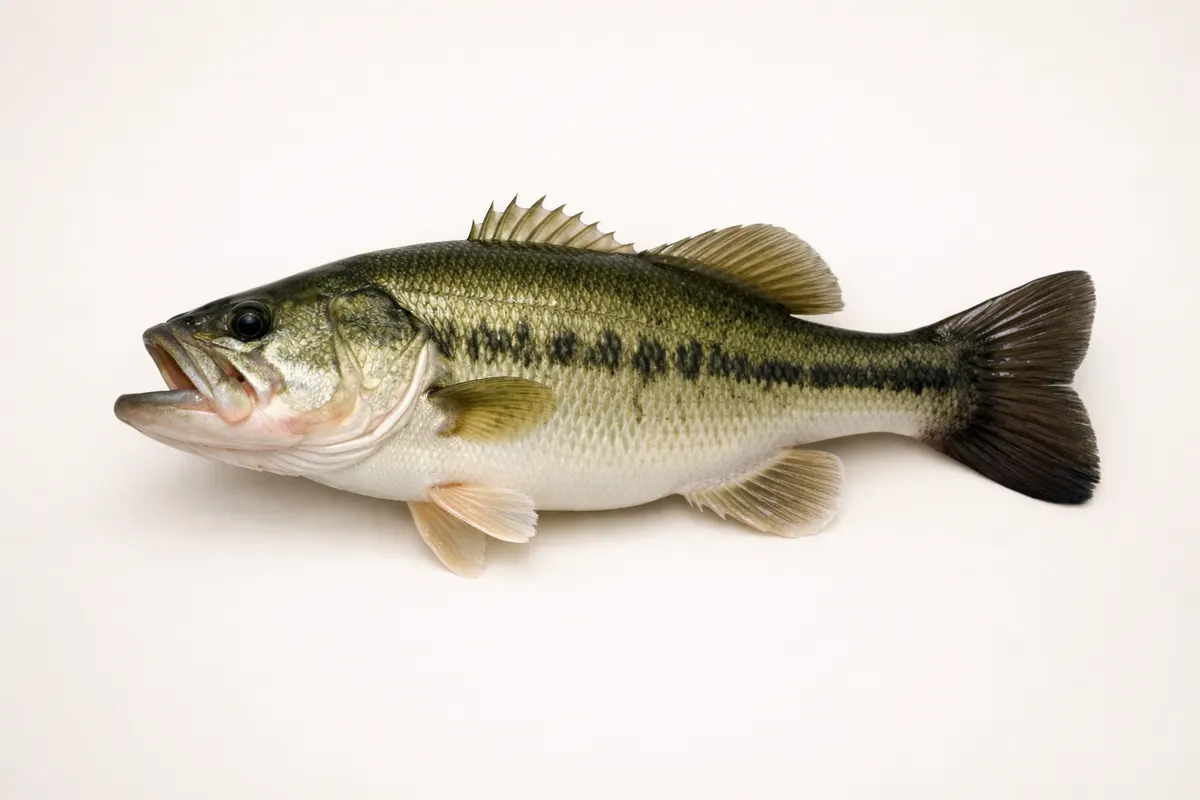
Largemouth bass overview and key traits
The largemouth bass (Micropterus salmoides) is a freshwater game fish known for a pronounced jaw that extends past the rear edge of the eye, a dark lateral stripe, and a chunky, laterally compressed body. It is a warm-water black bass in the sunfish family (Centrarchidae) and is one of North America’s most recognized freshwater sportfish.
Adults commonly measure 12–20 inches long and typically weigh 1–6 pounds in many lakes; fish exceeding 20 inches are considered trophy-sized. Size varies with habitat, food supply, and local fishing pressure, so length alone is not a definitive identifier without supporting visual cues.
The species is native to eastern and central North America and has been widely introduced elsewhere. It is known for ambush feeding from cover, preferring vegetated shorelines, fallen timber, and shallow structure near drop-offs.
- Scientific name: Micropterus salmoides
- Family: Centrarchidae (sunfish family)
- Common adult length: typically 12–20 inches
- Signature trait: lower jaw extends beyond the eye
Largemouth bass identification: photo clues
Focus first on mouth proportions and the lateral stripe. In clear photos a largemouth’s upper jaw extends past the rear margin of the eye—this is the single most consistent field mark you can use from one image. If the jaw clearly reaches beyond the eye when the mouth is closed, that strongly supports a largemouth ID.
Look for the broad, continuous dark stripe running along the side. The stripe may be solid or broken into blotches on older fish, but its horizontal placement and contrast against a greenish to olive back are characteristic. Note that lighting, algae, and water staining change perceived color, so interpret color with caution.
Check the dorsal fins: largemouths have a deep notch between the spiny (front) and soft (rear) parts of the dorsal fin but the two sections remain connected. Tail shape (slightly squared to rounded) and a relatively wide body profile—rather than the more elongated profile of some lookalikes—are useful supporting clues.
Use scale and cover context: photos showing the fish alongside vegetation, submerged logs, or depth markers help confirm typical largemouth habitat. A single photo of a severed tail, an obscured head, or extreme lighting reduces confidence; combine multiple views when possible.
- Jaw: upper jaw extends past rear margin of eye (key visual check).
- Lateral stripe: dark horizontal band along mid-body, continuous or blotched.
- Dorsal fin: connected spiny and soft sections with a noticeable notch.
- Body shape: deep, chunky body—less laterally compressed than some lookalikes.
Largemouth bass — quick facts
This compact facts table collects the attributes most useful when you need a quick, quotable summary for field notes or app scans. Use photo clues (jaw, stripe, fin notch) alongside these factual ranges to increase identification confidence.
| Attribute | Typical range | Photo clue |
|---|---|---|
| Adult size | 12–20 inches common; trophies >20 in | Compare length to known objects or angler hand |
| Coloring | Green-olive back, lighter belly | Look for contrast and lateral stripe |
| Habitat | Warm freshwater: lakes, ponds, reservoirs | Photos with vegetation or timber are telling |
| Active season | Most active spring–fall; spawn in spring | Belly color and condition change during spawn |
| Distinguishing feature | Jaw extends past eye; dark horizontal stripe | Jaw-line and stripe are primary photo checks |
Where and when you'll encounter largemouth bass
Largemouth bass is primarily a warm-water freshwater species. Expect to find them in vegetated shallows, weedy bays, backwaters, and around submerged structure such as logs and rock piles. They prefer slow-moving to still water where ambush hunting from cover is effective.
Seasonality matters: activity peaks in spring and early summer during pre-spawn and spawn when fish move into shallow cover and show brighter colors. Early morning and late afternoon are often the most active times in summer; colder months slow metabolism and reduce surface activity.
Introductions have expanded their range, so in some western U.S. reservoirs or non-native regions you may encounter largemouths in habitats that look different from eastern lakes—check local fishing reports and regulations before handling or moving fish.
| Region / habitat | When you'll see it | What you'll notice |
|---|---|---|
| Weedy lake margins | Spring and early summer mornings | Shallow fish near vegetation; darker lateral stripe |
| Ponds & small reservoirs | Warm months, dawn–dusk | Compact body, ambush posture near cover |
| Slow-moving rivers/backwaters | Spring through fall | Fish near fallen timber and submerged vegetation |
| Introduced populations (west, overseas) | Variable; often near structure | Similar jaw stripe but local size distributions differ |
- Typical habitats: vegetated lake margins, ponds, reservoirs, slow rivers
- Best photo chances: spring spawn (shallow), dawn/dusk in summer
- Local context: introduced populations may alter size and behavior patterns
- Regulatory note: follow local bag and season limits; do not assume uniform rules
Largemouth bass lookalikes and how to tell them apart
Two common lookalikes are the smallmouth bass and the spotted bass; each shares some marks with largemouths but has tell-tale differences you can often see in photos. Checking a few focused features—jaw length, stripe pattern, body shape, and jaw coloration—lets you rule alternatives in or out.
Smallmouths tend to have a smaller mouth (upper jaw does not extend past the eye), vertical bars rather than a continuous horizontal stripe, and a browner, more bronze coloration. Their bodies are usually more streamlined and the tail is more forked compared with a largemouth’s broader tail.
Spotted bass has a mouth size intermediate between smallmouth and largemouth and often shows distinct dark spots along the lower side or a broken lateral band. Spotted bass may also have a tooth patch near the tongue and a slightly different jaw angle; these finer details are sometimes visible in high-resolution photos.
- Smallmouth vs largemouth: jaw does not pass the eye on smallmouths; look for vertical bars on the flank.
- Spotted bass: broken stripe or spots on the lower flank; check for smaller mouth than a largemouth.
- White bass / striped bass: silvery bodies and different scale patterns—unlikely to be confused in close-up photos.
- When unsure, compare multiple angles: head, side, and tail views give the best chance to separate lookalikes.
Handling largemouth bass safely
If you plan to release a largemouth bass, minimize handling time and support the fish horizontally with wet hands or a wet cloth. Avoid squeezing the belly or placing thumbs inside the gill plates. Barbless hooks or quick hook removal reduce injury.
Observe local regulations for seasons and size limits before keeping a fish. During warm weather, limit air exposure and revive fish in moving water when possible. If a fish appears injured, photograph it for records and contact local fisheries if guidance is needed.
Do not interpret a single photo as definitive proof of species identity for legal or scientific uses; if verification affects compliance (for example, harvest or possession limits), consult a local fisheries officer or use multiple diagnostic photos and reputable expert resources.
- Wet your hands before contact; support body horizontally.
- Use pliers for quick hook removal; limit air exposure to under 15 seconds when possible.
- Follow local bag, size, and season rules—verification may require expert confirmation.
- If transporting, use aerated livewells and check local movement restrictions.
Frequently asked questions
How do I confirm a largemouth bass from a single phone photo?
Start by checking the jaw line: if the upper jaw extends behind the eye, that strongly indicates largemouth. Next, look for the dark horizontal stripe and the connected but notched dorsal fins. Note photo limits — poor lighting, unusual angle, or cropping reduce confidence. If the ID matters for legal or research reasons, take side and head-on shots and consult a local fisheries expert or the Fish Identifier app as a first pass.
What are the best photo angles to capture key largemouth bass features?
A clear side profile showing the head-to-tail line is ideal to see the lateral stripe and dorsal-fin notch. A close-up of the head at a slight angle shows whether the upper jaw passes the eye. Photos that also include context (vegetation, ruler or hand for scale) help estimate size and habitat—both valuable context clues when assessing identity.
What are the key clues for largemouth vs smallmouth bass in a photo?
Compare the jaw and flank pattern: largemouths have a jaw that reaches past the eye and a horizontal stripe; smallmouths do not have the jaw past the eye and usually show vertical bars or mottling instead of a long lateral stripe. Color can vary with water and light, so rely on jaw position and flank pattern as primary checks.
Can I rely on the Fish Identifier app to prove a largemouth bass for regulations or sale?
Use the Fish Identifier app as a helpful first-pass comparison against the visual clues on this page, but do not treat an app result as definitive proof for legal compliance or commercial transactions. Species-level verification for regulations or scientific purposes may require expert confirmation, multiple diagnostic photos, or a fish officer’s inspection.
Related guides
Compare your photo with largemouth bass clues
Open the Fish Identifier mobile app and compare your photo against the jaw, stripe, and fin clues listed here. Use side and head shots for the best match, and treat the app as a first pass—not a legal or scientific verification.