
Fish Identification
Rainbow Trout: How to Recognize the Fish by Photo Clues
Identify rainbow trout with photo-checkable marks, size and habitat clues. Learn when and where to expect them and safe next steps for photo comparison.
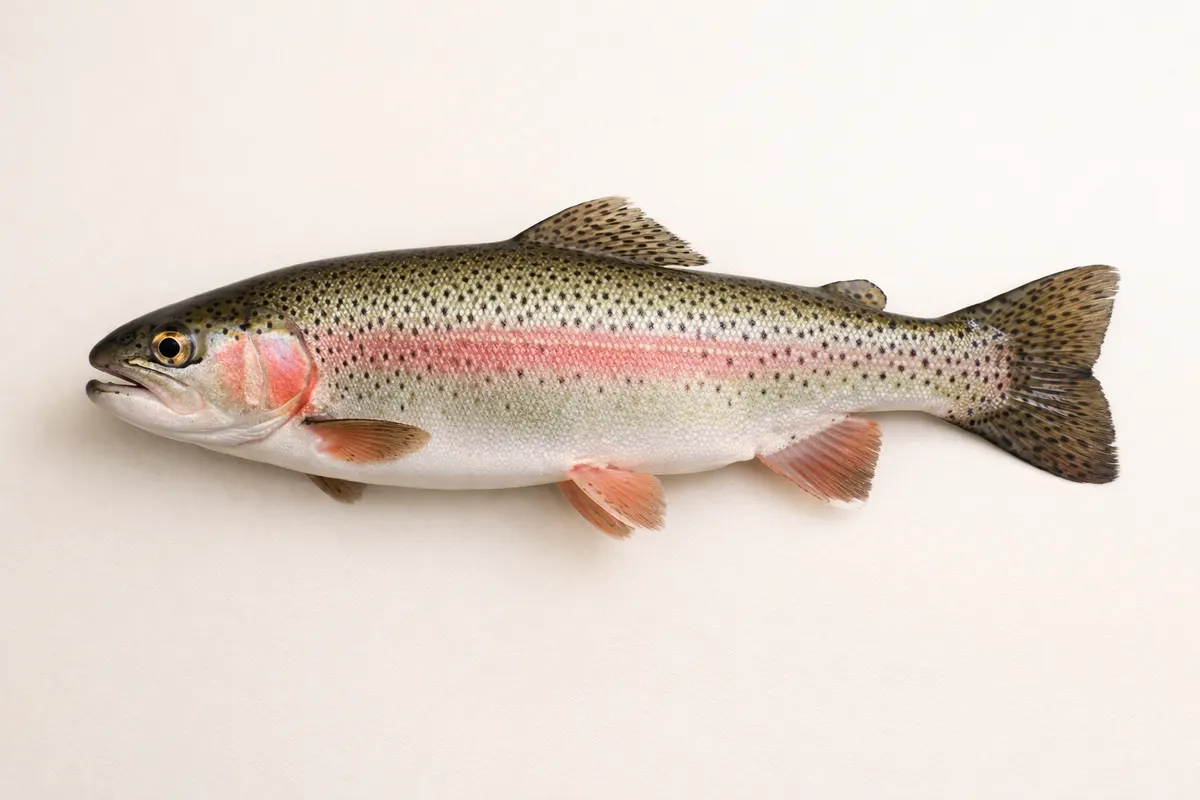
What a rainbow trout is and where it fits
The rainbow trout (Oncorhynchus mykiss) is a freshwater salmonid known for its lateral pink-to-red stripe, scattered black spots, and streamlined body. Adults typically stretch 12–30 inches (30–76 cm) depending on habitat and stocking history; inland stream populations are often smaller, while lake and anadromous forms can be larger.
Taxonomically, rainbow trout are in the Salmonidae family and share many traits with other trout and salmon: a single dorsal fin, an adipose fin (a small fleshy fin behind the dorsal), and an elongated fusiform shape suited for swimming in currents. The species is widely introduced outside its native range, which can complicate range-based ID if you only rely on location.
Field identification leans on a combination of color pattern, spot distribution, fin shape, and habitat. This species is known for the iridescent lateral stripe along its flanks, but stripe intensity varies with life stage, spawning state, and water clarity. Treat each visible clue as one piece of evidence rather than a single decisive marker.
rainbow trout identification: How to tell from photos
Start by photographing the whole fish from the side, with the body straight and fins visible. The most reliable photo clues are (1) a pink to red lateral stripe running from gill cover toward the tail, (2) numerous small black spots concentrated on the tail, dorsal fin, and upper body, and (3) an adipose fin present behind the dorsal. If the stripe or spots are faint, note background color and lighting rather than assuming absence.
Assess body shape and mouth position. Rainbow trout are more streamlined than brook trout and often have a terminal mouth (jaw ends roughly even with the snout). Steelhead (the anadromous form) may appear deeper-bodied or more robust depending on ocean feeding; I address those differences in the FAQ below.
Check scale and fin details: scales are relatively small and smooth; the dorsal and tail fins usually have scattered spots that continue onto the tail fin rays. The adipose fin is unspotted in many trout species but in rainbow trout it may carry a few faint marks—photograph it close-up if possible.
Use contextual clues in the image: water type (clear stream vs lake), surrounding substrate, and any visible tags or fin clips used by stocking programs. For certainty, combine photo clues with location and size estimates rather than relying on a single marking.
- Key photo subjects: full lateral view, close-up of head and gill cover, tail and dorsal fin, and the adipose fin.
- Markings to confirm: pink lateral stripe, black spotting pattern, spotted tail fin, and a small adipose fin.
- False positives to watch for: similar stripes from lighting or algae-covered fish; always cross-check with spot distribution and fin shapes.
Key facts about rainbow trout
A compact set of technical attributes can help you compare a photo to expected rainbow trout traits. Use the table below to match photographed features to typical ranges and to see which photo clues are most diagnostic.
| Attribute | Typical range / note | Photo clue to check |
|---|---|---|
| Size | 12–30 inches (commonly 10–20 in in streams) | Measure alongside a known object or estimate by hand span |
| Colouring | Olive to blue-green back, silver sides, pink-red lateral stripe | Look for iridescent stripe along midline |
| Spotting | Numerous small black spots concentrated on back, dorsal and tail | Check tail fin rays and upper body for dense spots |
| Fins | Single dorsal, adipose fin present, tail forked slightly | Photograph adipose fin and dorsal fin edge for comparison |
| Habitat | Cold, well-oxygenated freshwater: streams, rivers, lakes; anadromous form uses ocean | Note water type visible in image (riffle, pool, lake shore) |
| Distinguishing feature | Pink lateral stripe and spot pattern vs other trout | Stripe intensity and spot distribution are decisive in photos |
Where and when you'll encounter rainbow trout
Rainbow trout are native to the Pacific basin of North America but have been widely introduced worldwide into cold-water rivers, streams, and lakes. In many inland lakes and stocked streams they are the most commonly encountered trout species for anglers and shore observers.
Seasonality varies with local climate: in temperate zones you'll see active feeding in spring and fall when water temperatures are cooler; in alpine streams they remain active through summer in cold pockets of water. Anadromous steelhead migrate to and from the ocean on seasonal schedules that differ by watershed.
Time-of-day patterns are typical for trout: dawn and dusk often concentrate feeding activity, especially in rivers and streams. In bright midday light trout may seek deeper or shaded water, so a photo taken near the bank in low light is more likely to show feeding coloration and stripe contrast.
| Region / habitat | When you'll see it | What you'll notice |
|---|---|---|
| Mountain streams (native range) | Spring to early fall | Streamlined body, clear lateral stripe, feeding near riffles |
| Lakes and reservoirs (stocked or resident) | Spring, fall, and cooler summer mornings | Larger size, silvery flanks, sometimes fainter stripe |
| Coastal rivers (anadromous steelhead) | Run times vary by river—often late winter to spring or autumn | Deeper-bodied individuals, sometimes brighter colors pre-spawn |
| Introduced populations worldwide | Local stocking schedules; often year-round sightings | Variable size and color depending on hatchery genetics |
- Common settings: cool pools below riffles, lake inlets and outlets, tailraces below dams, and stocked municipal streams.
- Behavioral cues: tailing, riffle feeding, or surface sipping during hatches—these make identification by photo easier because the fish is often in view.
Fish most often confused with rainbow trout
Several species share superficial similarities with rainbow trout; photographs can exaggerate or hide distinguishing marks, so compare multiple clues when deciding. Below are the three most common lookalikes and the quick photo checks that separate them from rainbow trout.
Use body proportions, spot placement, mouth shape, and habitat context together. A single shared trait—such as a stripe or spots—does not equal a match; distribution and fin features are the decisive details.
- Brook trout: Often wrongly assumed to be rainbow trout because of colorful sides. Brook trout have worm-like vermiculations on the back and square tail with fewer scattered black spots; their lower fins carry white leading edges—photograph the pectoral and ventral fins to check.
- Brown trout: Brown trout lack the pink lateral stripe typical of rainbows and usually have larger, haloed spots (reddish or black) on a golden-brown flank; check for spot halos and the absence of a continuous pink stripe.
- Cutthroat trout: Cutthroat often show throat slashes (distinctive red/orange marks under the jaw) and a heavier spotting pattern toward the tail; an upward or downward extension of spots and the throat mark are key photo clues.
Care and handling for photographed or caught rainbow trout
If you are photographing a live trout in the field, minimize handling: keep the fish in water whenever possible, support its weight with wet hands, and use quick, well-framed shots. A clear lateral shot and a close-up of the fins will yield the best identification evidence without stressing the fish.
If the fish is caught and you must handle it, follow local regulations and best practices: remove hooks gently, revive the fish in current-facing water, and release when able. Legal limits and protected-status rules vary by region—always check local fisheries regulations before keeping or transporting any specimen.
- Photo tips for minimal harm: use a short hand-held ruler or a coin for scale, work quickly, and avoid removing the fish from water longer than necessary.
- Safety limits: do not assume you may collect or keep a specimen—respect seasonal closures, size limits, and protected runs (especially for steelhead/sea-run trout).
Frequently asked questions
Rainbow trout vs steelhead: How can I tell in a photo?
Steelhead are the anadromous (sea-run) form of Oncorhynchus mykiss and can look like rainbow trout, but there are photographic cues to separate them. Steelhead often appear larger and deeper-bodied, with a straighter, more silvery flank during ocean-feeding phases and heavier spotting on the tail. Pre-spawn steelhead may show darker, richer colors and a hooked jaw in males. Context helps: if the photo shows a coastal river during a known run period, treat a deeper-bodied, silvery fish as likely steelhead. Always combine body shape, spot distribution, size estimate, and location before concluding.
What should I photograph to improve rainbow trout identification?
Capture a full lateral view of the fish with the body straight, plus close-ups of the tail fin, dorsal fin, adipose fin, head/gill cover, and the mid-flank area showing the lateral stripe. Include an object for scale (hand, ruler). Also photograph the surrounding habitat (stream type, substrate) because water type and location are important supporting evidence for identification.
How reliable is a photo-based ID for rainbow trout?
A well-composed photo that shows multiple diagnostic features—lateral stripe, spot distribution, adipose fin, and body proportions—can provide a confident field ID, but it is never 100% certain. Factors such as lighting, angle, stress coloration, and hybridization can obscure key marks. Report your confidence level and the specific clues you relied on rather than asserting absolute certainty from a single image.
Are there legal or safety limits I should know when I find a trout?
Yes. Regulations about keeping trout vary by state, province, and country and often change seasonally, especially for anadromous runs like steelhead. Some populations are protected and require immediate release. If you plan to handle or keep a specimen, check local fishery regulations and follow catch-and-release best practices to reduce harm.
Related guides
Compare your photo against rainbow trout clues
If you want a quick second look, Fish Identifier can compare your photo against the visible clues described here. Use the app as an optional first pass to highlight matching marks—stripe, spot patterns, fin shape—then weigh that result alongside your habitat and size notes. Start a photo comparison at https://fish-identification.app/tools/fish-identifier and remember: a tool helps narrow possibilities but does not replace multiple evidence points or local regulation checks.
Take the next step →