Fish Identification
Walleye: Identification, Habitat, and Real Examples
Identify walleye from photos with eye, tooth and fin clues, lookalike checks against sauger, and the range and season where you are most likely to find them.
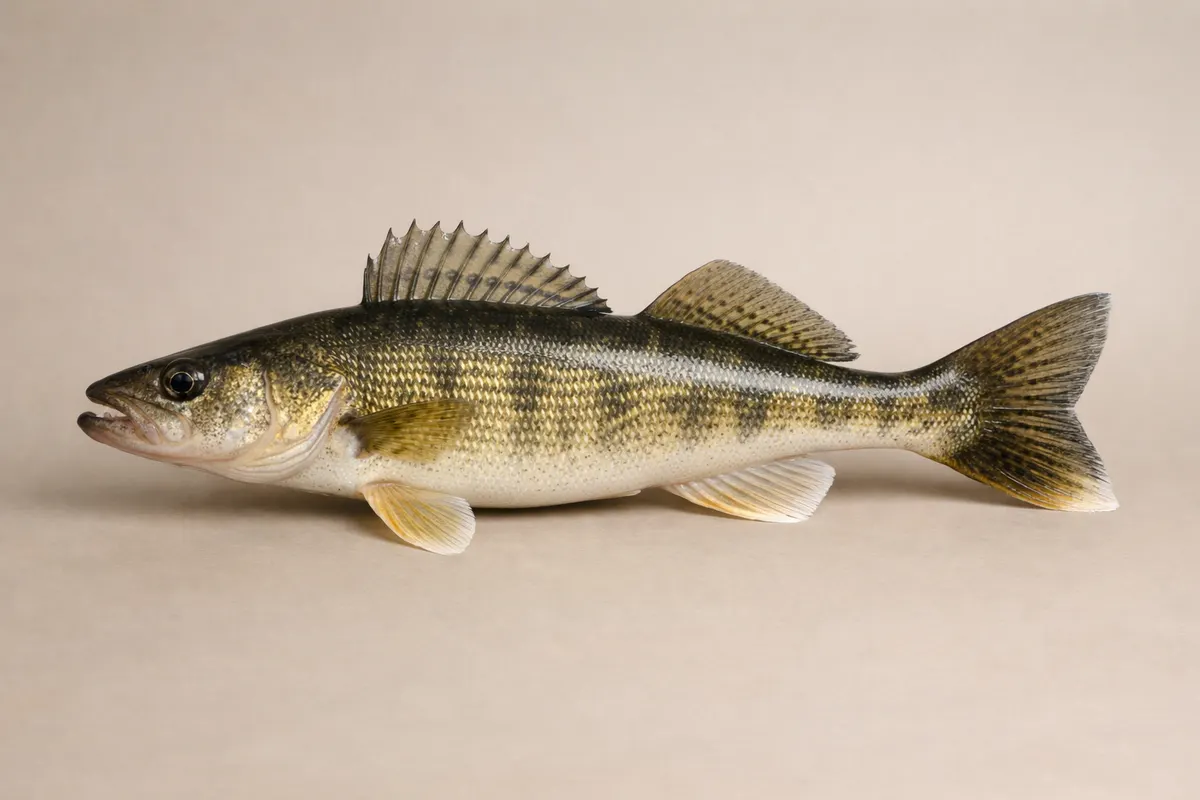
What a walleye is and where you’ll find it
The walleye (Sander vitreus) is a freshwater perch native to much of North America and a common target for anglers and fisheries. Recognized for its olive-golden sides, large reflective eyes, and a streamlined body, the walleye occupies lakes, large rivers, and reservoirs where low-light feeding gives it an advantage.
Adult walleye typically range from about 12–24 inches long in many inland waters, with trophy individuals exceeding 28 inches. They prefer cooler, deeper water during daylight and move shallower at dusk or during overcast conditions to feed on smaller fish and invertebrates.
Walleye are both a sporting fish and a food fish: they appear in recreational creel surveys, local fish markets, and as mounted trophies. When you examine a photo, include location, seasonal timing, and the water type — those contextual details strongly influence identification and value signals.
- Scientific name: Sander vitreus; family: Percidae.
- Typical adult length: 12–24 in; lifespan commonly 6–12 years in the wild.
- Habitat: lakes, reservoirs, and slow to moderate rivers, often near structure or drop-offs.
How do you do walleye identification from photos?
A reliable photo check focuses on a few repeatable, visible clues. Start with body shape and proportions: walleye are elongated with a pointed snout and two separate dorsal fins — one spiny, one soft-rayed. The eye is proportionally large and often appears glassy or reflective in photos taken at low light.
Coloration helps but varies with water, age and season. Look for an olive to golden flank, a pale belly, and darker saddles or blotches along the back. A thin, near-white leading edge or tip on the lower caudal (tail) fin is a common trait on many walleyes and can be a quick field cue in good photos.
Fin patterning and small details separate species: check the dorsal fins for rows of dark spots, count fin rays if visible, and note any distinct black blotch near the rear of the first dorsal. Always pair visual clues with context — geographic location, water type, and the fish’s size — because some traits overlap with related species.
- Eyes: unusually large and reflective, useful in low-light images but less reliable in bright sun.
- Color & markings: olive-golden sides, darker back with saddle marks; white or pale tips on lower fins often visible.
- Fins & shape: two dorsal fins (spiny then soft), elongated body, pointed snout — take clear side and top-angle photos when possible.
- Behavioral/context clue: dusk or murky-water activity and location near drop-offs or vegetation increase the chance a fish is a walleye.
Key facts and quick specs for walleye
The table below gathers compact identification facts that are easy to check in photos or field notes. Use these quick specs to confirm a sighting or to form a short list of candidate species before deeper comparison.
Remember that individual variation, regional subspecies, and juvenile coloration can change how these specs appear, so treat each row as a guideline rather than a definitive checklist.
| Attribute | Typical | Notes |
|---|---|---|
| Scientific name | Sander vitreus | Standard North American freshwater species |
| Adult length | 12–24 in (typical) | Trophy fish commonly exceed 28 in in select lakes |
| Coloration | Olive/golden with pale belly | Back darker with saddle-like blotches |
| Distinctive marks | Large reflective eyes; white-tipped lower fins | Dorsal fin patterning may help separate lookalikes |
| Habitat | Lakes, reservoirs, rivers | Prefers deeper water by day; feeds shallower at dawn/dusk |
Where and when you'll find walleye
Walleye are a big-water, low-light fish. The native range covers much of Canada from Quebec west to the Northwest Territories, the Great Lakes, and the Hudson Bay and Mississippi drainages south to Alabama and Arkansas, and stocking has extended them well past that into western reservoirs, the Columbia system and lakes across the Northeast. Expect them in large lakes, reservoirs and rivers with some current, over sand, gravel and rock rather than in heavy vegetation, and holding on structure - points, humps, weed edges, rock piles and drop-offs - rather than roaming open water.
Their light-gathering eye explains the timing. Walleye feed hardest at dawn and dusk, after dark, and through windy or overcast days when the surface is broken and the water is stained, so a fish that sits unseen in 20 feet of clear water at noon can be on a shallow flat at nightfall. The most predictable window of the year is just after ice-out, when they run rocky shoals and tributary rivers to spawn at water temperatures around 42 to 50 degrees Fahrenheit. Photos taken then skew heavily toward thick pre-spawn females and river fish.
| Season | Water temperature | Where they hold | Best time of day |
|---|---|---|---|
| Ice-out and spring spawn | About 42-50F | Rocky shoals, riprap, dam tailraces and tributary rivers | Night and the hours either side of dusk |
| Late spring to summer | About 55-75F | Main-lake points, humps, weed edges and drop-offs, commonly 12-35 ft by day | Dawn, dusk and after dark; shallower on windy, overcast days |
| Fall | About 45-60F | Steep breaks, river mouths and deep structure as fish group up | Late afternoon into darkness, when the largest fish of the year show |
| Winter, under the ice | Below 40F | Points, humps and the edges of deep basin flats | The last hour of daylight and the first hour after dark |
Walleye vs sauger: key differences
Walleye and sauger (Sander canadensis) are closely related and frequently confused. Size and overall color can overlap, but a few photo-checkable features usually separate them: sauger are generally smaller, often heavily spotted, and lack the bright white fin tips common on many walleyes.
In photos, check the dorsal fins and body spotting. Sauger tend to show clear dark spots on the first dorsal and more mottled side patterning. Walleye typically show a smoother golden flank and larger eyes. Geographic context matters: some waters host both species or hybrids, which complicates identification from a single image.
- Sauger: smaller, more pronounced dorsal spots, lacking consistent white lower-fin tips.
- Walleye: larger eyes, olive-golden sides, often pale or white lower-fin edges.
- Yellow perch & bass: differ in body shape and stripe vs. blotch patterns — check lateral line and fin shapes.
- When in doubt, note location and size, and compare dorsal-spot patterning and fin-tip coloration.
Care and handling for caught walleye
If you plan to keep walleye for eating, chill the catch quickly on ice and gut or bleed promptly — that preserves fillet texture and flavor. For market or home use, fillets handled cold and vacuum-sealed freeze well for months; always follow local advisories about consumption and contaminants.
For catch-and-release, support the fish horizontally, avoid squeezing the belly, and minimize air exposure. Use barbless hooks for easier releases, and revive exhausted fish in current before letting them swim away. For trophy mounts or preserved specimens, photograph the fish from multiple angles and record capture location and date for provenance before shipping to a taxidermist.
- Quick-chill kept fish on ice to preserve fillet quality.
- Minimize air time and handle gently for releases; support the fish horizontally.
- Document trophy specimens (photos, location, date) before transport for mounting.
Frequently asked questions
How large does a typical walleye get when fishing in my lake?
Typical adult walleye in many inland lakes fall between 12 and 24 inches; local 'trophy' thresholds are often 28 inches or more. Size depends on lake productivity, forage availability, and fishing pressure. Consult regional fishing reports or local anglers for lake-specific averages.
Can I age a walleye from a photo to estimate its value?
No — age estimates require scale, otolith, or growth-ring analysis and cannot be determined reliably from an image. Size can suggest relative age but varies by growth conditions; use photos only to estimate length and condition, not exact age.
What are the most helpful photos to take for identifying a walleye?
Take a clear side profile showing the full body, a close-up of the head and eye, and a detail shot of the dorsal and tail fins. Include a scale reference (ruler or known object) and note location, water type, and capture time for context — these details improve identification confidence.
Is it safe to eat walleye caught in areas with pollution concerns?
Safety depends on local contaminant advisories; walleye can bioaccumulate mercury and other pollutants. Check your regional fish consumption guidelines before eating. When advisories exist, they typically specify portion size and frequency to reduce risk.
Related guides
Compare your photo with Fish Identifier
Use the Fish Identifier iOS app to compare a photo of your catch against the visual clues listed here. The app can highlight likely matches and point out features to photograph next, but it cannot guarantee species, size, or market value from one image. Treat the app as a fast first pass and follow local rules or expert checks for final verification.