Fish Tail Shapes: Forked, Rounded, Square, and Crescent Tails
Learn which fish tail shapes a photo can reliably show, which clues are weak, and practical next steps to compare forked, rounded, square, and crescent tails.
Quick answer: what a tail shape can and can't prove
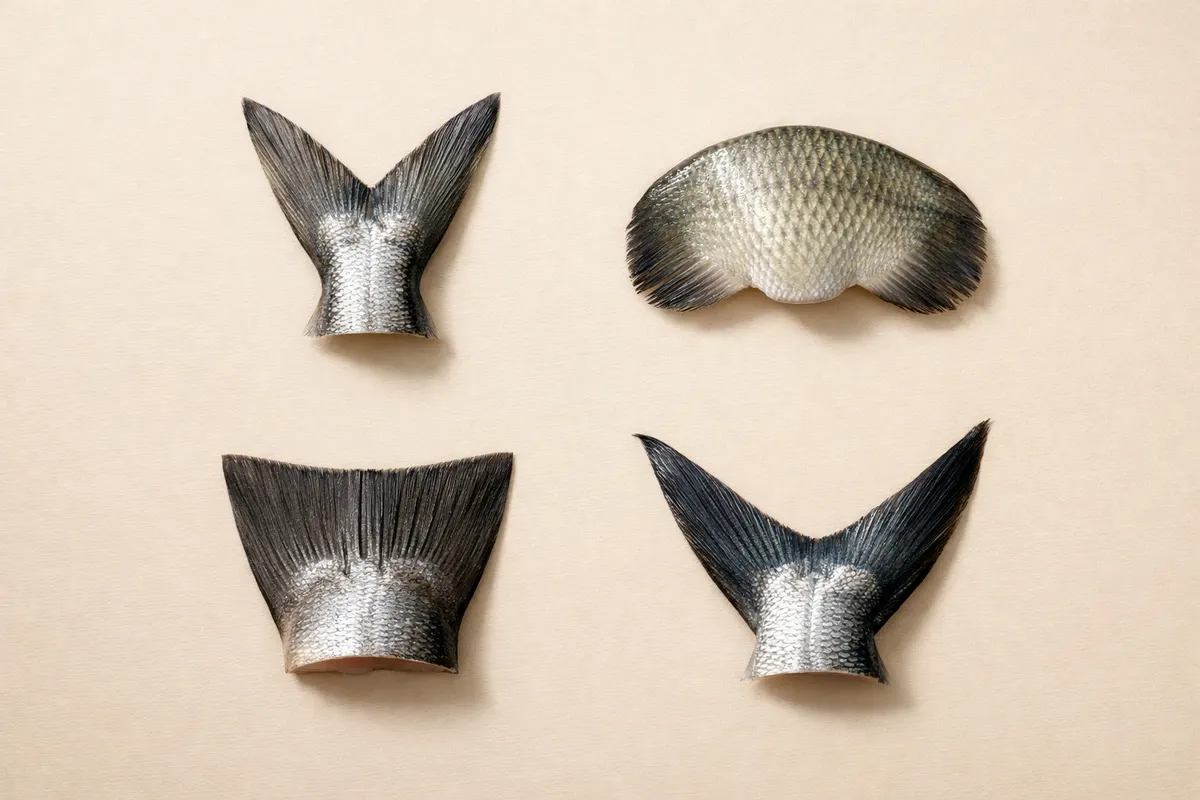
When you look at fish tail shapes in a photo, the most reliable information is the tail’s overall outline: whether it is forked, rounded, square (truncate), or crescent (lunate). Those silhouettes survive low light and modest blur better than fine color patterns or small spines. From silhouette alone you can often narrow the swimming style and a handful of candidate groups — for example, deeply forked or lunate tails usually indicate a fast, open-water swimmer; rounded tails often belong to slower, maneuvering fish in reefs or vegetation.
What a tail cannot prove by itself is the species. Tail shape is a strong functional clue but many unrelated species converge on the same tail architecture. Juveniles may have different proportions than adults, and damaged or regrowing tails can look like an entirely different shape. Treat a tail outline as one efficient filter in your identification workflow, not a final answer.
If your goal is a short list of possibilities, start with the silhouette and then check three supporting clues in your photo: the tail’s notch depth, the caudal peduncle width (the narrow area where tail meets body), and any distinctive trailing filament or extended lobes. Those three details collapses very large candidate sets quickly and are less likely to be lost to glare or mild motion blur.
After using those visual checks, follow up with context: where the fish was found, approximate size, and any visible body features. Use the tail as a high-value filter early in the process, then add other clues before you treat a match as reliable.
- Silhouette matters most: forked, rounded, square (truncate), crescent (lunate).
- Three durable checks: notch depth, caudal peduncle width, trailing lobes.
- Tail shape narrows possibilities but rarely gives a final species ID.
- Use habitat and size as quick, practical tie-breakers after silhouette checks.
Strong visual clues to read from a fish tail
When image quality is average—phone photo, not studio—the clues most likely to survive are structural features of the tail. Those include the depth and angle of the fork or notch, whether the lobes are symmetrical, the sharpness of the trailing edge, and the connection to the body at the caudal peduncle. These are physical shapes, not color details, so they’re less affected by lighting and white balance.
Notch depth: A shallow notch creates a truncate or slightly emarginate profile; a deep V-shaped notch produces a forked tail. Lunate (crescent) tails show a very deep, curved notch with long, narrow lobes; they are nearly crescent-shaped and are a hallmark of high-speed pelagic species. Measure notch depth roughly by imagining a straight line across the tips of the lobes and noting how far inward the middle drops compared with that line.
Caudal peduncle width: Look where the tail meets the body. A narrow peduncle plus long, tapered lobes signals sustained fast swimming; a thick peduncle with broad lobes suggests short bursts and strong maneuvering. That width stays visible even if color is washed out, so it’s a dependable functional clue.
Trailing features and symmetry: Many species have distinctive trailing filaments, marginal serrations, or scale extensions at the tail edge. Even when blurry, an asymmetric lobe or a small trailing filament can rule out entire groups. When you can detect those small but structured variations, document them with a close crop of the tail — that crop is often all an identification tool needs.
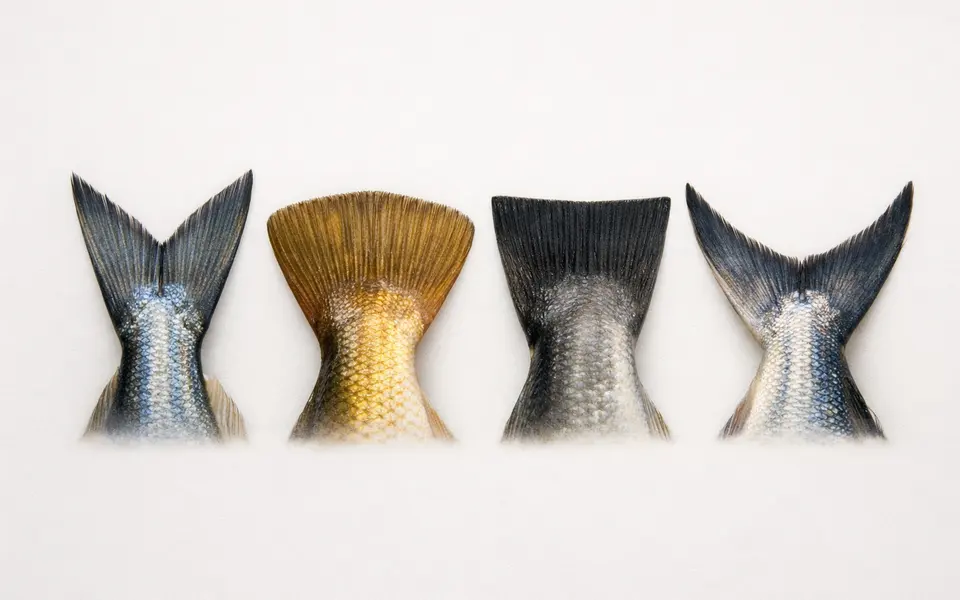
- Notch depth: deep = forked/lunate, shallow = truncate/rounded.
- Lobe shape: tapered lobes suggest fast swimmers; broad lobes favor maneuverers.
- Peduncle width: narrow peduncles are typical of pelagic, powerful swimmers.
- Trailing filaments or serrations are high-value micro-clues if visible.
- fish tail shapes clues
Weak signals
Color and small pattern elements are among the least reliable cues for tail-based ID because color fades with exposure, camera white balance changes, and reflection on wet surfaces. For example, a red fringe visible on one side of a tail may be a local stain, blood, or camera artifact rather than a species marker. Treat color as supportive evidence only after structural checks pass.
Single-angle photos create major traps. A tail photographed at a steep angle can look truncate when it is actually forked; foreshortening squashes lobes and hides peduncle narrowness. Similarly, glare and specular highlights on the wet tail can hide the notch entirely. Whenever possible take or request at least one near-perpendicular shot of the tail region.
Damage and regrowth: tails nicked by predators, nets, or hooks regrow with rounded ends that mimic naturally rounded or truncate tails. Age and development also matter: juvenile tails can be proportionally different and sometimes sport exaggerated filaments that disappear with maturity. Never rely on tail shape alone when there's visible trauma or obvious juvenile features.
Lookalike species: unrelated fish that share an environment often evolve similar tail plans for similar swimming needs. That means a forked tail alone can point to both members of the mackerel/tuna group and some active reef fishes. Use behavior, habitat, and body proportions to disambiguate rather than leaning on color or scale counts that may not be visible.
- Color is supportive, not definitive—check structure first.
- Single-angle photos can mislead; shoot or request a perpendicular tail view.
- Damaged or regrowing tails mimic other shapes—note scars or uneven edges.
- Juvenile tail proportions often differ from adults; confirm size and maturity.
- Avoid assuming function from form when several species share the habitat.
Step-by-step comparison workflow for tail-based IDs
Use this ordered checklist to turn a vague tail shape into a short list of likely matches. Working top-down reduces wasted comparisons: start with the silhouette, then layer micro-clues, then add body and context checks. Keep notes or a cropped image for each step so you can revisit earlier decisions.
Step 1 — Silhouette filter: Assign the tail to one of the primary silhouettes—forked, crescent (lunate), rounded, truncate/square. This immediately rules out many functional groups. If you can’t confidently place the tail in one silhouette because the photo is ambiguous, flag it and gather another angle.
Step 2 — Durable micro-clues: Record notch depth, peduncle width, lobe taper, and any trailing filaments. These features narrow the silhouette results into families. For example, a deeply forked tail with a narrow peduncle and long tapered lobes strongly suggests a pelagic scombrid or carangid rather than a reef perciform.
Step 3 — Cross-check body context: Compare with any visible body outline, dorsal fin shape, scale texture, and mouth orientation. Habitat notes (freshwater vs saltwater, reef vs open water) reduce confusion between lookalikes. If you have a geographic location and size estimate, use those to further filter candidate species.
- Step 1: Classify silhouette into forked, crescent, rounded, or truncate.
- Step 2: Log notch depth, peduncle width, lobe taper, and filaments.
- Step 3: Cross-check dorsal fin, body profile, and habitat notes.
- Step 4: Compare candidates side-by-side using cropped tail images.
- Step 5: If uncertain, collect one perpendicular tail shot and a full-body view.
Using an app after you check tail clues
After you complete the checklist above, use an identification app like Fish Identifier as a structured first pass: crop a clear tail image, add location and estimated size, and treat the app’s suggestions as research leads rather than definitive answers. The app is most useful when it receives the durable clues you’ve already extracted—silhouette, notch depth, and peduncle details—because those reduce false positives.
When you submit a tail-focused query in the app, include a short note about any ambiguity: 'tail possibly regrowing' or 'perpendicular shot not available.' That helps the app prioritize species that match the structural attributes rather than color. If the app offers multiple ranked matches, compare its top three with your checklist, looking specifically at differences in peduncle width and lobe taper.
If you want deeper help beyond the app results, use the site’s other visual-check guides. For example, the What Type of Fish Is This guide provides a fuller visual checklist and examples that pair well with tail-based filtering: https://fish-identification.app/blog/what-type-of-fish-is-this. Keep in mind the app and guides are complementary: the app speeds candidate generation; your checklist and habitat notes improve final judgment.
When a match is uncertain, treat the app output as research notes. If you plan to rely on the ID for anything important—consumptive decisions, legal reporting, or biological records—seek an expert verification or multiple confirming images that show head, dorsal fins, and body markings in addition to the tail.
- Crop a focused tail image and add location + size when using the app.
- Flag ambiguous photos (regrowth, juvenile, foreshortening) in your note.
- Compare the app’s top 3 matches against your tail-clue checklist.
- Consult broader visual guides if the app results disagree with physical clues.
Related guides
Use Fish Identifier as a next step after your tail checklist
Once you’ve checked silhouette, notch depth, and peduncle width, use the Fish Identifier app on your phone to generate candidate matches. Crop a clear tail image, add the location and an approximate size, and treat results as research leads—compare the top matches against your checklist and any full-body photos you can collect. If identification matters for safety or legal reasons, seek confirmation from an expert rather than relying on a single photo.

Frequently asked questions
What fish tail shapes examples should I expect when my photo only shows the tail?
If your photo only shows the tail, expect silhouettes like forked, rounded, truncate (square), and crescent (lunate). Forked tails often appear V-shaped with two distinct lobes; crescent tails are deeply notched and more curved, while rounded tails have a continuous curved edge. Use notch depth and peduncle width from the crop to separate possibilities. Remember that damaged tails and juvenile tails may mimic other silhouettes, so add habitat and size if available before narrowing to species.
How can I tell a crescent (lunate) tail from a deeply forked tail in a blurry photo?
Even when blurry, crescent (lunate) tails usually show very narrow, sharply tapered lobes and an almost symmetrical crescent outline, while deeply forked tails have lobes that are less tapered and often show a noticeable angle at the tip. Check the peduncle: lunate tails often attach to a narrow, stiff peduncle for sustained speed. If blur makes lobes indistinct, compare multiple frames or request a perpendicular close crop to reveal the tapering.
Can tail shape alone tell me if a fish is fast-swimming or a slow maneuverer?
Tail shape gives strong directional hints but not absolute proof. Lunate and deeply forked tails correlate with sustained high-speed swimmers that travel in open water. Rounded or truncate tails tend to belong to fish that rely on maneuverability in structured habitats like reefs or vegetation. However, exceptions exist: some benthic or ambush predators have unusual tails. Use tail shape as a functional indicator and confirm with body plan and habitat.
How should I record fish tail shapes clues to improve identification later?
Save a cropped image of the tail at full resolution, note location, depth or habitat, and an estimated size. Write a brief observation about any damage, juvenile features, or asymmetric lobes. These notes make it easier to compare candidates later and help apps or experts prioritize matches. A short checklist (silhouette, notch depth, peduncle width, filaments) recorded with the photo is often enough for a confident revision.