
Fish Identification
Muskellunge: Identification, Habitat, and Real Examples
Practical muskellunge ID guidance: photo-check clues, range and season, lookalikes, and safe handling. Use evidence-based checks before trusting a single image.
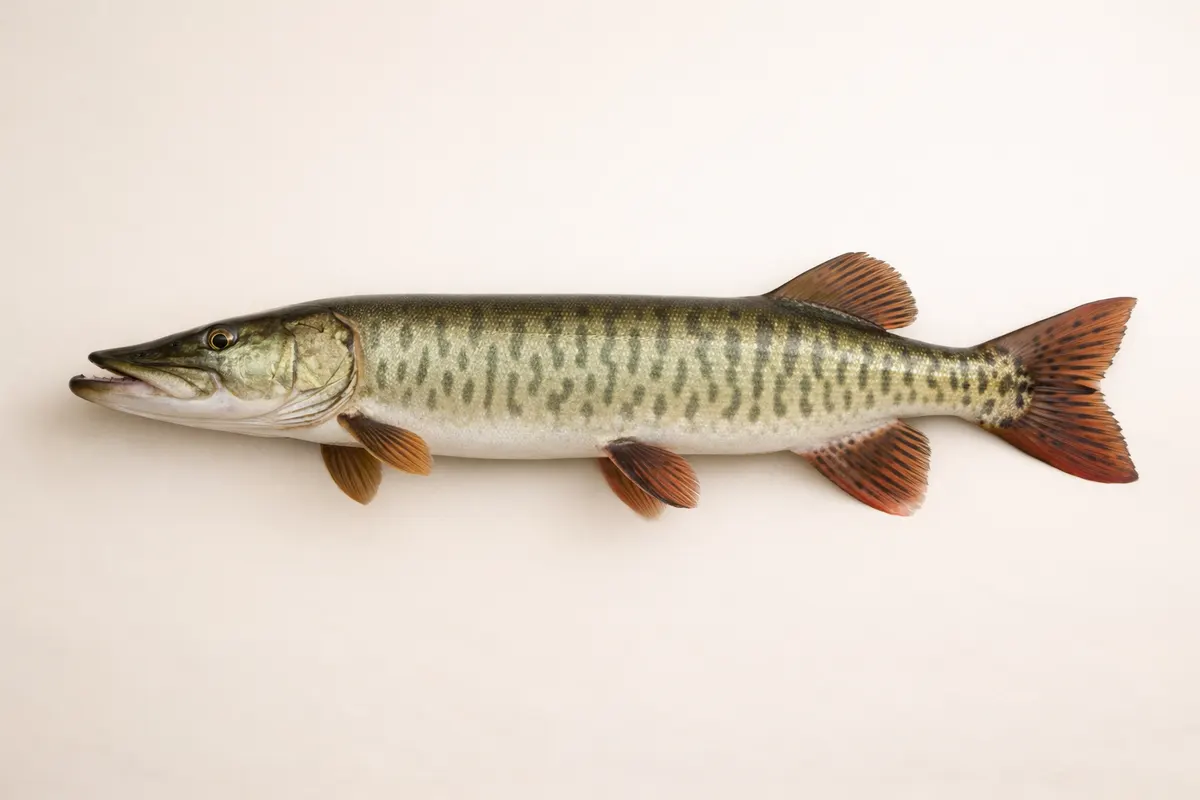
What is a muskellunge and where it lives
The muskellunge (Esox masquinongy), often shortened to muskie, is a large freshwater predator in the pike family (Esocidae). Adults have an elongate, torpedo-shaped body, a long pointed snout, and a dorsal fin set far back on the body—features shaped for ambush hunting in clear, structured water.
Muskellunge are native to parts of eastern and central North America: the Great Lakes, St. Lawrence system, upper Mississippi basin, and many northern lakes and rivers in the U.S. and Canada. Local populations vary in size and coloration, with some populations showing light bodies with dark markings and others the reverse.
They are known for relatively slow growth to large sizes and a reputation among anglers for powerful strikes and elusive behavior. Because they are apex predators, their presence often signals healthy aquatic habitat with abundant forage and suitable cover.
Muskellunge identification: How to tell one in a photo?
Photographing a potential muskellunge? Start with overall body shape: a true muskellunge has a long, narrow profile with the dorsal fin positioned well back, roughly over the posterior half of the body, and a flattened, duckbill-like snout. Those proportions distinguish it from deeper-bodied species.
Next, check the scale and mark pattern. Muskellunge populations show three common pattern types: light background with vertical bars, light background with scattered dark spots, or dark background with light spots. The arrangement tends to be linear and elongated along the flank rather than irregular blotches.
Tail (caudal fin) shape and markings are useful. Muskellunge tails are slightly forked to truncate, and many have distinct spotting that continues onto the tail. A broad, rounded caudal peduncle—where the tail attaches—is another cue to watch for in side-on photos.
Always pair visual clues with context: size estimates from nearby objects, habitat in the image (rocky or vegetated shoreline, submerged timber), and the fish’s behavior (suspended near weed edges, slow stalking) help confirm an ID. Single photos can mislead—note what you can and what you can’t see, and treat any photo-based ID as provisional.
- Head and snout: long, pointed snout; lower jaw often slightly projects.
- Dorsal fin placement: far back on body, behind midline.
- Body pattern: vertical bars or rows of spots (region-dependent).
- Tail markings: spots or bands continuing from the body onto the caudal fin.
- Size cues: adults commonly exceed 28 inches; use objects in the frame to estimate length.
- Behavioral cues: ambush spots—weedlines, rock points, submerged wood—are common in photos.
Key facts about muskellunge
A compact set of attributes helps summarize what to expect when you encounter a muskellunge. Use the table below as a quick reference for size, typical colouring, habitat, seasonal activity, and the single most reliable distinguishing trait visible in photographs.
| Attribute | Typical | Notes |
|---|---|---|
| Size | 28–48 in (70–120 cm) adults | Large individuals exist; use objects for scale in photos. |
| Colouring | Light with dark bars, light with spots, or dark with light spots | Pattern type varies by region and age. |
| Habitat | Large lakes, rivers, vegetated shorelines, submerged structure | Prefers clear water and ambush cover. |
| Active season | Spring through early fall in temperate zones | Most visible in spring spawning and cooler shoulder seasons. |
| Distinguishing feature | Dorsal fin far back + long duckbill snout | Fin placement and head shape are photo-checkable. |
Where and when you'll see muskellunge
Muskellunge sightings concentrate in cooler, northern freshwater systems with clear water and structure. In many regions they are most visible during spring spawning runs and again in cooler months when they move into shallow feeding zones. Time of day can matter—dawn and dusk are common feeding windows.
When interpreting photos, pair the physical environment in the image with seasonal timing. A long, torpedo-shaped fish photographed near a weedline in early May in a Great Lakes tributary is more plausibly a muskellunge than a shore-caught bass photographed in midsummer.
| Region / Habitat | When you'll see it | What you'll notice |
|---|---|---|
| Great Lakes basin lakes and rivers | Spring and fall movement; summer in deep structure pockets | Large specimens near rock points or weed edges |
| Upper Mississippi & northern inland lakes | Spring spawning and cooler months | Ambush behavior around submerged logs and weedbeds |
| St. Lawrence and Canadian Shield lakes | Late spring through early autumn | Clear water visibility; pattern types vary by lake |
| Slow rivers with deep pools | Warm days when hunting near current breaks | Often solitary; photographed near current seams |
Species commonly confused with muskellunge
The most frequent lookalikes are the northern pike, chain pickerel, and (less commonly) very large bass in poor light. Photos that crop tightly on the head or are taken at odd angles lead to most misidentifications—body proportion and fin placement are the keys to separate them.
Northern pike (Esox lucius) is the closest relative and the usual source of confusion. Pike often have a shorter, blunter snout and a pattern of light markings on a darker background in many populations; however, regional color overlap exists. Focus on proportions: pike tend to have a relatively deeper body and broader head.
Chain pickerel are smaller with a distinctive chain-like pattern and a dark bar beneath the eye; size and pattern usually rule them out for large specimens. Very large bass can look pike-like in low-quality photos, but bass have a different mouth angle and a dorsal fin divided by a noticeable notch.
- Northern pike — tell-tale: proportionally deeper body and different snout profile.
- Chain pickerel — tell-tale: chain-like flank markings and smaller adult size.
- Largemouth bass — tell-tale: notched dorsal fin, larger mouth extending past eye when viewed head-on (see Largemouth Bass: Identification, Habitat, and Real Examples).
- Bluegill and other sunfish — rarely mistaken for adult muskellunge, but juvenile forms of other predators can confuse scale and proportion in photos (see Bluegill: Identification, Habitat, and Real Examples).
Handling muskellunge safely
Muskellunge have very sharp, inward-pointing teeth and a powerful body. For anglers and photographers, the safest approach is to minimize handling: keep the fish in the water where possible, use long-nose pliers or lip grips designed for large predators, and support the fish horizontally if you must lift it for a quick photo.
Check local regulations before any interaction—many jurisdictions have slot limits, seasonal closures, or mandatory release rules for muskellunge. Always treat a single photo or image-based ID as provisional; when in doubt about rules or species confirmation, consult local fisheries authorities.
Frequently asked questions
Muskie vs pike: Which did I photograph from my lake dock this morning?
Start by comparing head shape and fin placement in your photo. If the dorsal fin sits far back over the posterior half of the body and the snout is long and narrow (duckbill-like), the fish is likelier a muskellunge. Northern pike often show a relatively deeper body and a shorter, broader snout. Also compare pattern: pike often have light spots on a darker background in many waters, while muskellunge patterns can be vertical bars or aligned spots depending on the population. If the picture lacks side-on proportion or has poor lighting, treat the ID as provisional and combine the image clues with habitat and size estimates.
How reliable is a single photo for muskellunge identification?
A single clear, side-on photo can be very helpful, but it is rarely definitive by itself. Perspective, lens distortion, foreshortening, and water surface glare all change perceived proportions. Best practice is to capture multiple angles: a full side profile for body proportions and pattern, a head-on or three-quarter shot to check snout shape, and a photo including a reference object for scale. Always note location and date—habitat and season are important corroborating evidence—and treat the image-based ID as a starting point rather than a final expert confirmation.
What should I photograph to improve muskellunge identification?
Aim for a sharp side profile that shows the full body from snout to tail; that reveals dorsal fin placement, flanks, and caudal markings. Include a second close-up of the head (snout and jaw line) and, if safe, a shot of the tail and pectoral fins. Place a recognizable object (boat rail, ruler, hand with glove) discreetly in frame for scale. Avoid extreme zoom that crops out fin placement, and capture habitat context—weedlines, submerged timber, or rocky points help rule in or out muskellunge based on typical settings.
Are there legal or safety limits I should know about when handling a muskellunge?
Yes. Many regions impose size or slot limits and some apply mandatory release for muskellunge; others limit possession during spawning windows. Before handling or keeping a specimen, consult local fish and wildlife regulations to avoid fines and to protect populations. For personal safety, use tools—long-nose pliers, gloves rated for fish handling, and a firm cradle or net—and minimize air exposure and handling time to reduce stress on the fish.
Related guides
Compare your photo to muskellunge clues with Fish Identifier
After you’ve checked the clues on this page—fin placement, snout shape, pattern, and habitat—use Fish Identifier as an optional, first-pass comparison. Visit https://fish-identification.app/tools/fish-identifier to run a photo comparison from your device; treat the app’s result as an evidence check only and verify any ID with habitat context or local authorities before acting.
Take the next step →